
What Is Maayan HaChinuch HaTorani and Why Was It Created?
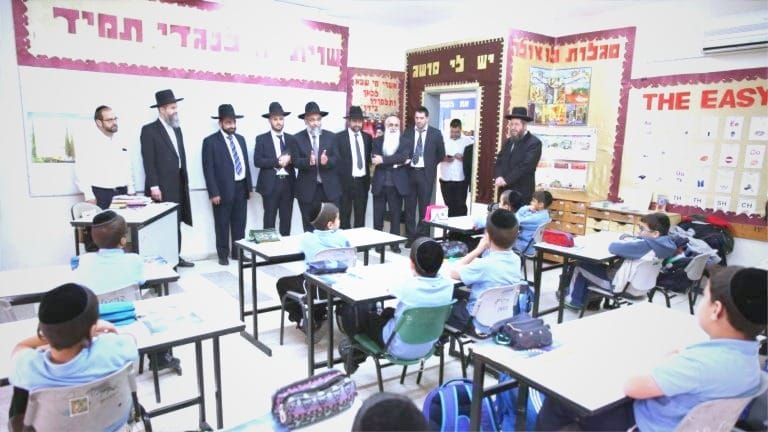
Maayan HaChinuch HaTorani is the Sephardi Charedi school network of Eretz Yisrael, founded in 1984 under the leadership of Maran Chacham Ovadia Yosef. Its purpose was twofold and inseparable: to rescue a generation of Sephardi children who were slipping away from Torah, and to restore something that had been allowed to fade almost to nothing — the glory of Sephardi Torah itself. It is the educational heart of the Shas revolution, and to understand it you have to understand the double wound it was built to heal.
I. A Double Wound
The first wound it shared with the rest of religious immigrant Jewry. In the early decades of the state, hundreds of thousands of deeply religious Jews arrived from Morocco, Iraq, Tunisia, Yemen, and across the Sephardi world, and were too often funneled — in the ma'abarot and the development towns — into a secular education that left a great many of their children cut off from observance within a single generation. That story is told in full elsewhere in this series, in the account of Chinuch Atzmai.
But the Sephardi world carried a second wound that was entirely its own, and it cut just as deep. Even inside the Torah world, the Sephardi mesorah was being treated as second-class. Sephardi boys who entered the great Ashkenazi yeshivos were quietly expected to leave their fathers' traditions at the door — to daven in an Ashkenazi nusach, adopt Ashkenazi customs and pronunciation, and absorb the sense that the real Torah was the one being taught in someone else's accent. A heritage of staggering grandeur — the heritage of Maran the Beis Yosef, of the great chachamim of Spain, North Africa, Bavel, and Yemen — was in danger of being quietly forgotten, or absorbed away, by its own children. Sephardi Jewry was losing some of its sons to secularism on one side, and risking the rest to a slow erasure of their own identity on the other.
II. Chacham Ovadia's Vision: Restoring the Crown
Against both wounds stood one towering figure. Chacham Ovadia Yosef — the Rishon LeTzion, a posek of such encyclopedic command that even those who differed with him could not ignore him — gave his life to a single banner, captured in three words: l'hachzir atarah l'yoshnah, to restore the crown to its former glory. He set out to hand Sephardi Jewry back its own Torah, in full: its own poskim restored to their rightful authority, with Maran the mechaber once again the binding voice of Sephardi halacha; its own minhagim, its piyutim, its nusach; and, above all, its pride — the unapologetic knowledge that Sephardi Torah was not a folkloric relic to be tolerated but a living crown to be worn.
And he understood the one thing that turns a vision into a future: a restoration that does not reach the children does not last. The crown could not merely be argued for in books of responsa. It had to be placed, every morning, on the head of a child opening a Chumash. The restoration had to happen in the classroom.
III. The Birth of Maayan
It came in 1984, alongside the founding of Shas — the movement that was born when Sephardi bnei Torah, weary of being sidelined and slighted within the Ashkenazi-dominated Agudah, resolved to stand on their own. Maayan HaChinuch HaTorani became its educational arm. Its beginnings were grassroots and humble: a few dozen small Talmudei Torah, opened by determined Sephardi educational activists, already teaching thousands of children who had nowhere else to go. With the political and financial backing of the newly elected Shas, and the religious authority of the Sephardi Gedolim behind it, that scattering of chadarim grew within a few short years into a national network educating tens of thousands.
IV. What It Built
Today Maayan operates more than 130 schools throughout Israel — Talmudei Torah for boys, Beis Yaakov-style schools for girls, and a network of preschools and kindergartens that catch children at the very start — reaching tens of thousands of students, by some counts well over fifty thousand. And it planted itself precisely where the need was greatest and the neglect had been longest: in the development towns and poorer neighborhoods of the periphery, in places like Netivot, Be'er Sheva, Ashdod, Elad, and Tzfas, where Torah education had too rarely been offered with seriousness and pride. What it provides there is a full Torah education in an authentically Sephardi key — the learning, the halacha, the nusach, and the minhagim of the child's own ancestors — under the guidance of the Sephardi Gedolim.
V. The Gedolim Behind It
Maayan has been carried by the giants of the Sephardi Torah world. Chacham Ovadia Yosef stood at its head as founder and spiritual leader until his passing in 2013, mourned by a city that filled with hundreds of thousands. After him, Chacham Shalom Cohen — Rosh Yeshiva of Porat Yosef, the yeshiva that rebuilt Sephardi Torah scholarship from the ruins of 1948 — led the Council of Torah Sages until his own passing in 2022. The work is carried forward today by Chacham Moshe Maya and by Chacham David Yosef, Maran's son and a leading halachic authority of the next generation. It is no accident that so much of this leadership flows from Porat Yosef: that yeshiva was the engine room of the entire Sephardi restoration, and Maayan is what happened when its vision was scaled to reach an entire people's children.
VI. Holding the Line on Chinuch
Like its Ashkenazi counterpart, Maayan has had to defend its independence against a familiar pressure: the state's recurring effort to tie funding and recognition to a "core curriculum" set on the Ministry's terms. Its leadership has kept the chinuch of its children in its own hands — its curriculum, its teachers, and its hashkafa determined by the Sephardi Gedolim rather than by government officials — and has declined to absorb content that runs against its Torah values. And where the choice has come down to it, Maayan has been willing to forgo the additional funding rather than surrender the principle, on the same simple conviction that built the network in the first place: a child's Torah is not for sale.
VII. The Impact: A Crown Restored
The fruit is now visible across the country. Tens of thousands of children have been given a Torah education that their grandparents' generation very nearly lost. An entire stratum of Sephardi avreichim, rabbanim, and dayanim trace their first Mishnayos back to a Maayan cheder in a development town that the establishment had long written off. Traditional, masorti families — the warm, faith-filled Sephardi homes that were never quite "Charedi" yet never stopped loving Hashem — have been drawn back toward Torah rather than away from it. And in town after town, something less measurable but no less real has been restored: pride. The quiet, settled knowledge that Sephardi Torah is not secondary and not nostalgic, but a living inheritance, carried again with dignity.
That is what Chacham Ovadia built. Not only schools, but the return of a people's Torah to its rightful honor.
Maayan HaChinuch HaTorani is, in the end, what l'hachzir atarah l'yoshnah looks like when it is poured into children. It rescued a generation caught between two losses — secularism on the one hand and the forgetting of its own mesorah on the other — and handed it back the Torah of its fathers, whole and unashamed. The crown that Chacham Ovadia spent his life lifting from the dust now rests, every single morning, on the heads of tens of thousands of Sephardi children as they open their sefarim. There could be no greater monument to the man, and no truer one to the Torah he loved.
May the crown of Sephardi Torah shine ever brighter, may every Jewish child be raised in the light of his own mesorah, and may we merit the complete restoration of Torah to Klal Yisrael — bimheirah b'yameinu, amen.
Sources
The founding and its purpose
- The establishment of Maayan HaChinuch HaTorani in 1984 as the educational network of the Shas movement, founded under the leadership of Maran Chacham Ovadia Yosef to provide a Torah education to Sephardi children and to restore the standing of Sephardi Torah — l'hachzir atarah l'yoshnah, to return the crown to its former glory
- Its growth from a grassroots cluster of Sephardi Talmudei Torah into a national network of more than 130 schools, concentrated in the development towns and periphery, educating tens of thousands of students
The leadership
- Chacham Ovadia Yosef (founder and spiritual head until his passing in 2013); Chacham Shalom Cohen, Rosh Yeshiva of Porat Yosef (head of the Council of Torah Sages until his passing in 2022); and, today, Chacham Moshe Maya and Chacham David Yosef — the leadership rooted in Porat Yosef, the yeshiva that rebuilt Sephardi Torah scholarship after 1948
The structural relationship to other articles in this series
- "What Is Chinuch Atzmai and Why Was It Created?" — the parallel network and the shared struggle over immigrant education
- "Does the State of Israel Try to Force Secular Education in Charedi Schools?" — the curriculum battle in its present form
- "What Does the Word 'Charedim' Mean?" and "How Do Charedim Uplift Israeli Society Through Chessed?" — the wider world this education builds