
What Are the Practical Challenges of Full-Time Torah Learning, and How Do Families Manage?
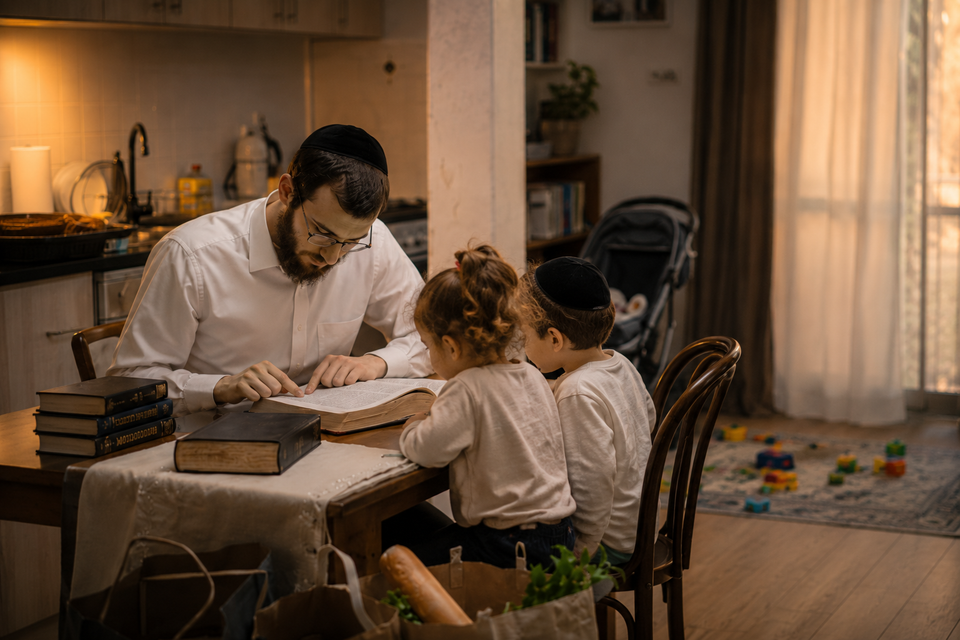
Rent is high, groceries are expensive, tuition is relentless — and still, thousands of families across the world build their lives around full-time Torah learning, and do it with genuine joy. The honest answer to "how do they manage?" is not that it is easy. It is that they have decided, with open eyes, that it is worth it — and that a whole framework of family, community, and emunah rises up to make it possible.
Look at a young kollel couple from the outside and the math seems impossible. A modest stipend, a growing family, the same bills everyone else pays — and one spouse spending his days not earning but learning. It is fair to ask how it works, and it deserves an honest answer. The truth is that kollel life is genuinely hard, that the families living it know exactly how hard it is, and that they sustain it through a combination of real sacrifice, real support, and a conviction about what they are doing that the outside world often doesn't see. Let us be honest about all three.
I. The Challenges, Without Sugarcoating
It would be dishonest to pretend the difficulties are minor. They are real and they are daily.
The first is financial. Kollel stipends are modest — the figures vary widely by place and year, but a kollel check in Eretz Yisrael is often only a couple of thousand shekel a month, and in the United States frequently in the range of several hundred to around a thousand dollars. That does not cover rent, let alone food, clothing, utilities, and the medical and tuition bills that come with a family. The second is the relentless rise in the cost of living, which presses on these households as hard as on anyone — harder, with a single modest income. The third is instability: very often it is the wife who carries the parnasa, frequently in chinuch, administration, design, or healthcare — work that can be flexible but rarely offers long-term security.
And there is a fourth challenge that is not financial at all: being misunderstood. Outside the Torah world, full-time learning is sometimes written off as idleness, even parasitism. That charge stings, and it is also, in the Torah world's understanding, simply mistaken — for reasons this series takes up at length elsewhere, in explaining how Torah learning protects and sustains all of Klal Yisrael. A family living on little so that one of them can hold up that end of the Jewish people is not taking from the nation. In its own self-understanding, it is giving to it. But the misunderstanding is a weight these families carry all the same, and it would be wrong to leave it off the list.
II. The Way of Torah Has Always Asked for Sacrifice
None of this is new, and that is part of how these families hold it. The Mishnah described the path centuries ago, with startling bluntness: "This is the way of Torah — bread with salt you shall eat, water in measure you shall drink, on the ground you shall sleep, a life of hardship you shall live, and in Torah you shall toil" (Avos 6:4). The acquisition of Torah was never promised to be comfortable; the very same Mishnah that exalts it warns that it is bought with simplicity and labor.
This is the inheritance of Volozhin, of Slabodka, of Radin — generations of bnei Torah who chose less of the world in order to hold more of the Torah, and who are remembered not for what they lacked but for what they built. Rav Shach was known to teach that a life of Torah without sacrifice is not yet fully a life of Torah; the willingness to give something up is part of what makes the Torah one's own. Mesiras nefesh — the readiness to sacrifice for something higher — is not an unfortunate side effect of kollel life. It is, in this understanding, woven into what Torah is.
And yet — and this matters — the tradition is not naïve about the cost. The very same Pirkei Avos that calls for sacrifice also states plainly: "If there is no flour, there is no Torah" (Avos 3:17). Judaism never pretended that a family can live on idealism alone, or that material need is shameful to acknowledge. The challenge is real, the tradition says so openly, and the greatness lies not in denying the hardship but in carrying it for the sake of something one treasures more.
III. How Families Actually Manage
So how, concretely, does a kollel home stay afloat? Through several supports at once, none of them magic and all of them real.
Simplicity. These families live on less, and largely by choice. Secondhand furniture, modest apartments, few luxuries, vacations that are rare or absent. It is not deprivation worn as a badge — it is a deliberate ordering of priorities, spending little on what they consider secondary so they can afford what they consider essential.
The supporting spouse — a partnership with deep roots. Where one spouse learns and the other earns, the Torah world does not see a lopsided arrangement but an ancient and honored partnership: that of Yissachar and Zevulun, the brothers whom Yaakov and Moshe blessed together, one devoted to the tent of study and the other to the work that sustained it — sharing equally, the tradition teaches, in the reward of the Torah produced (Bereishis 49; Devarim 33:18). A wife who works so her husband can learn is not a footnote to his Torah. She is a full partner in it, and the seforim treat her share as no smaller than his.
Family. Very often parents, grandparents, and in-laws step in — sometimes with money, but just as importantly with babysitting, with Shabbos meals, with a hand to hold a young family steady. Whole extended families buy into the mission together.
Community. Kollelim themselves provide stipends and subsidies; communities run food programs, kimcha d'Pischa before Pesach, and large chesed organizations — Kupat Ha'ir, Vaad HaRabbanim, and many others — that quietly carry thousands of families through tight months. A Torah community is built to hold up its learners.
And bitachon. Underneath all of it runs a trust that the outside world finds hardest to see, and that these families find most real. "A person's sustenance is fixed for him from Rosh Hashanah," the Gemara teaches (Beitzah 16a) — with one striking exception: what a Jew spends on Shabbos, Yom Tov, and his children's Torah education is not counted against that fixed sum; spend more on those, and more is given. Kollel families take that promise at its word. They will tell you, in nearly identical words across a thousand homes, "Hashem will help" — and they will point to the unexpected gift, the timely job, the neighbor who appears at the door with supper, as evidence that He does. None of this is a guarantee of ease, and they know it. But the help, when it comes, very often arrives precisely through these channels — family, community, and the quiet hand of Hashem moving through them.
IV. Not Just Surviving — Living for Something
It would miss the whole point to describe these families only as coping. In their own experience, they are not merely getting by; they are living for something, and they feel it.
The seforim call a Jewish home where Torah and the Shechinah dwell a mikdash me'at, a miniature sanctuary (Megillah 29a, on Yechezkel 11:16) — and Rav Moshe Feinstein was known to describe the kollel home in just those terms, a small Beis HaMikdash built of sefarim and bitachon rather than stone. These are homes with little on the walls but seforim, and a great deal in them: warmth, clarity of purpose, children who grow up understanding that a life is measured by what it is devoted to and not by what it owns. There is a teaching of Chazal that every mitzvah a person does creates a defending angel (Avos 4:11); in that spirit, Rav Aharon Leib Shteinman was known to marvel at the avreich who drags himself to the beis medrash after a sleepless night with a crying baby — that he cannot imagine what such quiet, unwitnessed devotion brings into being above. The Chazon Ish, in his writings on bitachon, taught that the plain kollel yungerman who keeps learning through real hardship stands higher in Heaven's eyes than the mightiest of warriors.
The families themselves feel the dividends in ordinary moments: a difficult sugya that finally opens, a child reciting a dvar Torah at the Shabbos table, a neighbor who knocks for advice because there is something in the home he can sense. These are not consolations for a hard life. To them, they are the life.
V. Conclusion: Earned, and Therefore Treasured
So, no — full-time Torah learning is not easy, and this publication will not pretend otherwise. The bills are real, the sacrifices are real, and the families living this life feel every ounce of the weight. But they would tell you that the difficulty is not the flaw in the arrangement; it is part of what makes what they hold so precious. A gift earned through sacrifice is held differently than one that costs nothing.
Through that sacrifice — borne with simplicity, carried by spouses and families and whole communities, and underwritten by a trust in Hashem that has never yet failed Klal Yisrael — the families of lomdei Torah become something the outside world rarely recognizes when it does the math: not a burden the nation carries, but a quiet engine at its very heart.
May Hashem grant every family that gives itself to His Torah ample parnasa, good health, and nachas, and may He lighten their load and answer their bitachon — bimheirah b'yameinu, amen.
Sources
The way of Torah and the place of sacrifice
- Avos 6:4 — "This is the way of Torah: bread with salt you shall eat… a life of hardship you shall live, and in Torah you shall toil"
- Avos 3:17 — "If there is no flour, there is no Torah; if there is no Torah, there is no flour" — the tradition's honest acknowledgment that material need is real and not to be dismissed
The partnership that sustains learning
- Bereishis 49 and Devarim 33:18 — the partnership of Yissachar and Zevulun, the learner and the one whose labor sustains him, sharing equally in the reward; the model for the supporting spouse and family
Sustenance and bitachon
- Beitzah 16a — "a person's sustenance is fixed for him from Rosh Hashanah," with the exception that expenditures on Shabbos, Yom Tov, and one's children's Torah education are not drawn from that fixed sum
The Torah home
- Megillah 29a, on Yechezkel 11:16 — the concept of the mikdash me'at, the miniature sanctuary
- Avos 4:11 — that each mitzvah creates a defending angel
The structural relationship to other articles in this series
- "Why Is Torah Learning the Top Priority?" — why a family would choose this in the first place
- "How Is Torah Learning Seen as Benefiting Every Jew?" and "How Does Torah Learning Protect Klal Yisrael?" — the answer to the charge of "parasitism"
- "Is Kollel a Modern Invention?" — the historical roots of full-time learning
- "Do Charedim See Working as a Religious Value?" — the place of parnasa in the Torah worldview