
One Law for the Yeshiva, Another for Everyone Else
Two headlines appeared this week that seem unrelated. In one, the IDF worries that Charedi recruits are abandoning its showcase Chashmonaim Brigade in droves. In the other, MK Simcha Rothman reveals that yeshivos are being stripped of their tax-deductible status while organizations that glorify terrorists keep theirs. Read them together, and they tell one story: the campaign marching under the banner of "equal burden" is neither equal, nor about the burden.
I. The Brigade the Arrests Are Emptying
Begin with the army's own numbers, as reported this week from inside its recruitment apparatus. The Chashmonaim Brigade is the IDF's flagship Charedi combat framework — the track the state points to whenever it insists that Charedi service is possible. The army invested heavily in it: active batei medrash, three tefillos a day, Torah learning frameworks, mehadrin kashrus, an environment designed from the ground up for the Charedi recruit. Recruitment is built on painstaking personal outreach — meetings, screening interviews, long conversations to build trust with candidates and their families.
And it is collapsing. Sources inside the recruitment effort report a sharp rise in young men who begin the enlistment track and then halt or cancel — no longer isolated cases but dozens, walking away after already entering the screening stages. The army expected the brigade to grow to several hundred recruits per intake. In the most recent cycle, in May, it drew about seventy — seventy, out of an annual pool the IDF itself estimates at some fourteen thousand. And when the recruiters ask the candidates why, the answer is consistent: the arrests. The brothers, cousins, and friends taken from buses and homes. A community that has watched its sons handcuffed is not sending more sons.
Let us be transparent about where we stand, because our readers know it well: the gedolim oppose these programs, and this publication has explained why at length. We shed no tears over the shortfall. But that is precisely why the story matters — because it is not our logic collapsing here. It is the state's.
II. If They Wanted Soldiers, Would They Do This?
Think it through with cold clarity. A government that genuinely, desperately needed Charedi soldiers had exactly one asset that produced them: a voluntary track, built on years of trust-building, drawing the small minority of young men whose families were willing to consider it. That trust was the entire machine. And the state took a hammer to it — night arrests, checkpoint detentions, criminal warrants — knowing full well, because its own recruiters were telling it, that every arrest was burning the voluntary pipeline down.
A state that wanted soldiers would never torch the only field that was growing them. A state that wants something else — submission, precedent, the breaking of a community's autonomy — would do exactly this, because coercion is not a means to its end. It is the end. The Chashmonaim collapse is not an unfortunate side effect of the enforcement campaign. It is the proof of what the campaign was always for.
III. Rothman Pulls Back the Curtain
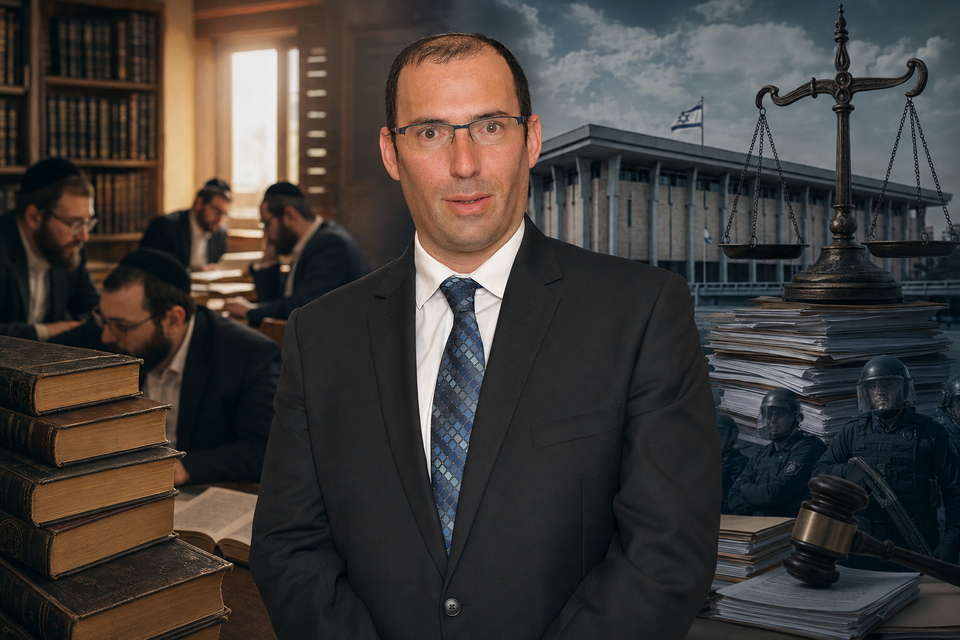
Now to the second headline. MK Simcha Rothman, chairman of the Knesset's Law Committee — not a Charedi politician, but a Religious Zionist one — went on Reshet Bet this week and said what the legal establishment prefers left unsaid. Yeshivos and Torah institutions are being stripped of their Section 46 status — the provision that makes donations tax-deductible — while, he testified, when he sought to revoke that very status from organizations that defame IDF soldiers and glorify terrorists, it was the government's own legal advisers who stood firm to protect their funding. The High Court, he noted, reinstated child benefits for terrorists who served prison sentences — while the yeshivos lose their standing. His verdict: persecution of the Charedi sector, completely disproportionate.
And alongside the revocations came a demand that should chill anyone with a memory: the Tax Authority requiring yeshivos to submit lists of their students, with identity numbers. A registry of who sits in the beis medrash, compiled by the state, as a condition of a tax status that every amuta in the country enjoys unconditionally. Jews have seen registries of yeshiva students before. They were never compiled for the students' benefit.
Rothman's terror comparison is shocking, and he is right to make it. But we will do something harder: set it aside. Forget the extreme cases. The double standard does not need them — because it is visible in the state's treatment of its most ordinary, law-abiding citizens.
IV. The Ledger — What Is Aimed at One Community
Assemble, in one place, what has been directed at the Charedi public since the exemption was struck down in June 2024. The blanket funding cut: hundreds of millions of shekels stripped from the yeshivos. The Attorney General's order cutting daycare subsidies — a thousand to seventeen hundred shekels per child, per month — from kollel families whose fathers ignore call-up notices, a lever aimed deliberately at young mothers and infants. The criminal classification of bnei Torah as deserters. Military police at family doors. Forty-six bochurim detained over a single Shabbos. Stay-of-exit orders that have turned Ben Gurion Airport into a trap — avreichim arrested at passport control in front of their children; chassanim unable to fly to their own engagements; an entire Chassidishe shidduch system, built on international matches, thrown into crisis, until the Va'ad HaYeshivos, at Rav Dov Landau's instruction, forbade any ben yeshiva with a draft order from leaving the country at all. And now the newest instruments: Section 46 revoked, and the student registry demanded.
Every item on that list is aimed at one community. Now ask the question the campaign's slogan invites: is this equal burden under equal law?
V. The Equality Audit
Because here is what the slogan conceals. The Security Service Law, on its face, applies to every citizen of Israel. Yet roughly a fifth of the country's citizens — the Arab public, Muslim and Christian — is simply never called. Not by statute; by settled administrative practice, sustained across every government the state has ever had. And let us say what follows with complete clarity, because it is the heart of the matter:
No Arab citizen has ever been arrested at Ben Gurion Airport for failing to enlist. No church school or mosque or Arab community institution has been stripped of funding, or of Section 46 status, over its graduates' non-service. No stay-of-exit orders. No military police at the door. No demand that Arab schools submit student lists with identity numbers as a condition of their tax standing. No Attorney General's letter cutting daycare subsidies to Arab mothers because the fathers did not report to a recruitment office. Nothing. And we cast no stone whatsoever at those citizens — hear this clearly. We do not demand their conscription; the arrangement may well be wise policy for a complicated country, and they are entitled to live their lives in peace. The Druze community, whose sons do serve — and serve with distinction — has our genuine respect, as do the Bedouin who volunteer. Our argument is not with any community in this land.
Our argument is with a state that maintains total, untroubled forbearance toward one non-serving fifth of its citizens — and unleashes airports, registries, prisons, and hunger-of-the-purse against another. With a High Court that struck down the yeshiva exemption in the name of equality — that word, precisely — and has never in its history ordered enforcement, sanctions, or funding conditions on any other non-serving population. Equality, it turns out, has an address. It applies on one street only, and that street runs through Bnei Brak.
VI. One Law — By Their Own Standards
We could cite the Torah's standard of one law for all. But the state does not claim to be bound by the Torah — so let us hold it, instead, to the standards it does claim, proudly and in writing.
Its own Declaration of Independence promises all the state's inhabitants "complete equality of social and political rights" irrespective of religion. Its own Basic Law: Human Dignity and Liberty is the text from which its Supreme Court derived the very principle of equality it now wields — and equality was the entire stated basis of the June 2024 ruling against the yeshivos: the Court declared that a state may not maintain one rule for one group and another rule for everyone else. Very well. Apply that ruling to its authors. A legal system that hunts one non-serving community with airports, registries, subsidy cuts, and prison cells, while extending seventy-five years of untroubled forbearance to another non-serving fifth of the population, violates the precise principle in whose name it acted. And Israeli law has a name for this: its own courts have long recognized that selective enforcement — achifah bereranit, the targeting of one party for sanctions that identically situated parties are spared — is an abuse that can taint the enforcement itself. By the state's own doctrine, an "equality" that is a sword honed for a single community and sheathed for all others is not equality. It is discrimination wearing equality's robes, and it stands condemned out of the state's own mouth.
And understand what we are asking for, because it is the opposite of what our accusers claim. We do not ask that anyone else be coerced — not the Arab citizen, not the secular evader, not anyone. Coercion of conscience is the thing we oppose, for everyone. We ask only for what every other non-serving community in this country receives without asking: forbearance. The same quiet, sensible accommodation of a population "ideologically disconnected," in Rabbi Levinstein's phrase, that the state has extended to a fifth of its citizens for seventy-five years without a single arrest. Extend to the people of the Torah what you extend to everyone else, and this entire crisis ends tomorrow morning.
VII. The Two Headlines Answer Each Other
So read the week's news again, together. The state's voluntary Charedi track is dying — killed by the state's own handcuffs, as its own recruiters testify. And the state's legal machinery is inventing instrument after instrument — funding cuts, subsidy cuts, exit bans, tax revocations, registries — deployed against Jews who learn Torah and no one else. A campaign that destroys its own recruitment while perfecting its punishments has told you its priorities. It was never about the soldiers. It was never about equality. It is about whether a community may exist in this land on the Torah's terms — and to that question, with respect and without fear, our answer has not changed in three thousand years.
May Hashem shelter every ben Torah and every Jew in this land, grant its rulers the wisdom of one just law, and speedily bring the day when the only badge anyone demands of a Jew is the Torah itself.
Sources
The two reports at the center of this piece
- The Walla report (via Yeshiva World News) on the sharp rise in Charedi candidates halting or canceling enlistment to the Chashmonaim Brigade — roughly 70 recruits in the May cycle against an IDF-estimated pool of 14,000, with candidates citing the arrests of brothers, relatives, and friends
- The Reshet Bet interview of MK Simcha Rothman, chairman of the Knesset Law Committee, on the revocation of Section 46 status from yeshivos while the legal establishment protected the status of organizations that defame soldiers and glorify terror, and the High Court's reinstatement of child benefits for imprisoned terrorists; the Tax Authority's demand that yeshivos submit student lists with identity numbers
The enforcement ledger
- The June 2024 High Court ruling striking the yeshiva exemption and ordering funding cuts; the Attorney General's order cutting daycare subsidies (NIS 1,000–1,700 per child) for families of yeshiva students who ignore call-up notices; the detention of 46 bochurim over a single Shabbos; the stay-of-exit orders and arrests at Ben Gurion Airport, the resulting crisis in the Chassidishe shidduch world, and the Va'ad HaYeshivos directive, at the instruction of Rav Dov Landau, forbidding bnei yeshiva with draft orders from leaving the country — as reported by Yeshiva World News, Israel National News, and the Jerusalem Post
The standard of one law — the state's own
- The Declaration of Independence's promise of complete equality of social and political rights irrespective of religion; Basic Law: Human Dignity and Liberty and the Supreme Court's equality jurisprudence, on which the June 2024 conscription ruling itself rested; the Israeli courts' own doctrine against selective enforcement (achifah bereranit); the settled administrative practice under which the Arab citizens of Israel, roughly a fifth of the country, are not conscripted and face no enforcement, funding conditions, or institutional sanctions — alongside the honored service of the Druze community
The structural relationship to other articles in this series
- "Side by Side, Not Apart: What the Chief of Staff Just Told Us About the Draft" — the manpower story, tested and found wanting
- "The Secular Establishment Wants to Assimilate the Charedim Through the Draft" — the aim the enforcement ledger reveals
- "Why Charedim Frown on Charedi IDF Programs" — where we stand on the brigade itself, and why
- "The Charedi View on How Taxes Are Spent" — the funding question in full
- "Here's a Thought: Maybe Stop Kidnapping Our Children" — the arrests, answered directly