
Not Even for a Minute
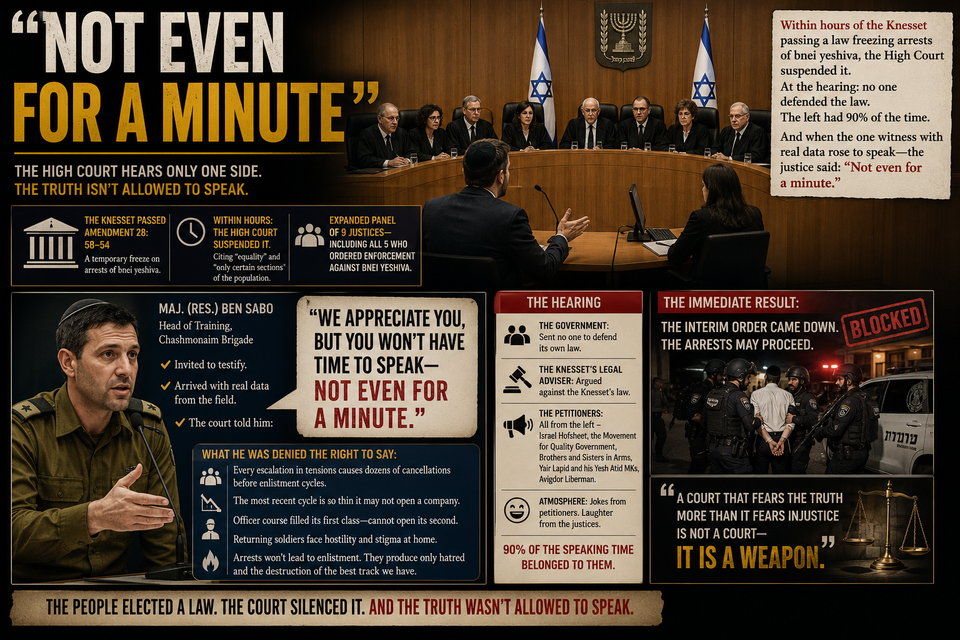
The Knesset passed a law freezing the arrests of bnei yeshiva. Within hours, the High Court suspended it. At the hearing on its fate, nine justices sat before a courtroom in which — remarkably — no one at all defended the law: the government sent nobody, and the Knesset's own legal adviser argued to strike it down. The petitioners, all from the left, held the floor ninety percent of the time, trading jokes with the bench. And when the one witness with actual field data rose to speak — the head of training of the army's own Charedi brigade, invited to testify that the arrests are destroying enlistment — the presiding justice told him: we appreciate you, but you won't have time to speak. Not even for a minute. Remember that sentence. It is the whole story of this Court in seven words.
I. The Stage
First, the verified facts of what this hearing was. The Knesset — the elected legislature of the State of Israel — passed Amendment No. 28 to the Security Service Law by 58 votes to 54: a temporary measure, in force until November 30, freezing arrest, investigation, and enforcement proceedings against qualifying bnei yeshiva, in order to allow the status of Lomdei Torah to be regulated until a new government resolves the draft question. A modest pause. Not an exemption, not a repeal — a breather, voted by the people's representatives, to stop the handcuffing of Torah students while the country heads to elections.
The Court's response was immediate. Justice Ofer Grosskopf issued a provisional order suspending the law before it could take effect, and a conditional order demanding the state explain why it should not be annulled — citing, of course, "only certain sections of the population" and the principle of equality. (Our readers may consult "One Law for the Yeshiva, Another for Everyone Else" for a full audit of what that principle means in this Court's hands.) An expanded panel of nine justices was appointed for the hearing — and here the composition itself tells a story. The panel includes all five justices who authored the Court's sharply worded November 2025 and April 2026 rulings ordering enforcement against bnei yeshiva: Sohlberg, Barak-Erez, Mintz, Willner, and Grosskopf. In other words: a law whose entire purpose was to soften the consequences of those rulings was placed for judgment before the very judges who wrote them. In any other context, this is called being a judge in one's own cause. Here it is called an expanded panel.
And one more detail the Israeli press itself found remarkable: Court President Yitzchak Amit left himself off the panel — along with Justice Kabub — with no explanation. Channel 12's Amit Segal noted it is hard to recall a case in which the president did not sit on an expanded panel of this kind, leaving Deputy President Sohlberg to absorb the public fire; Charedi reporting described the selection as a tactical maneuver. Absorb what that means: the Court itself arranged the seating with an eye to managing public backlash. That is not the behavior of an institution confident it is doing law. It is the behavior of an institution that knows it is doing politics.
II. The Hearing Maj. Sabo Walked Into
Into this arena came Maj. (res.) Ben Sabo — the head of training of the Chashmonaim Brigade, with the brigade since its establishment a year and a half ago. He was invited by the law's defenders to give the Court something it could get nowhere else: authentic testimony from the field, without theories, from the man who runs the training of the army's own Charedi combat framework.
What he found, he told Arutz Sheva, stunned him. The government, on Shas chairman Aryeh Deri's reasoning that the justices would strike the law regardless, had declined to send anyone to defend its own legislation — and the Knesset's legal adviser appeared in order to argue against the Knesset's law. So the courtroom contained: nine justices, and a row of petitioners drawn entirely from one political camp — Israel Hofsheet, the Movement for Quality Government, Brothers and Sisters in Arms, Yair Lapid and his Yesh Atid MKs, Avigdor Liberman. Ninety percent of the speaking time, by Sabo's account, belonged to them. The atmosphere, he said, was collegial to the point of farce — attorney Eliad Shraga told jokes and the justices burst into laughter, while the audience sat stunned. "It looked like a working meeting of the radical left," he said. And when, after roughly ninety minutes, the moment came for the one witness carrying field data, Deputy President Sohlberg delivered the line: the head of training of the Chashmonaim Brigade has indeed arrived; we appreciate you, but you won't have time to speak — not even for a minute. We'll inform you of our ruling later today.
Later that very day, the interim order came down. The arrest freeze was blocked. The arrests may proceed.
III. The Testimony They Refused to Hear
So let the record show, here, what the Court declined to spend sixty seconds on.
Sabo came to testify that the brigade began with tremendous momentum and professionalism — and that the arrests are strangling it. His numbers, from inside the recruitment process: every escalation of tensions produces dozens of cancellations in the week before an enlistment cycle. The most recent cycle was so thin it is not certain a company can be opened. The brigade's professional officer course filled its first class — and cannot open its second, because no soldiers will volunteer. Soldiers returning home report hostility and stigma, finding themselves branded as adversaries of their own community, and are finding it ever harder to remain. His conclusion, delivered now to the press instead of the bench: it is obvious that arrests will not lead to enlistment, and the organizations inflaming the confrontation are achieving only one thing — hatred, and a widening wedge between the religious and Charedi publics.
(One note of precision our readers will expect of us: Sabo described the brigade as founded with encouragement from Charedi rabbanim across the spectrum, for young men for whom full-time learning is not their path. That is his account of his project, and we report it as such. Our readers know well where the gedolim stand on these frameworks, and that whatever quiet, case-by-case allowances have ever existed for individuals fully outside the beis medrash are a far narrower matter — one we have treated with care elsewhere. Nothing in this article turns on that dispute; what matters here is what the Court did with his data.)
IV. The Tell
Now think it through, because this is the heart of the matter — and it convicts the Court out of its own conduct.
The High Court's entire stated project, across two years of rulings, is Charedi enlistment in the name of equality. Very well: here is the head of training of the only Charedi combat brigade in the IDF, the man personally responsible for turning Charedi recruits into soldiers, holding data on what actually produces enlistment and what destroys it. If enlistment were truly the goal, there is no witness in the State of Israel the justices should have wanted to hear more. His testimony is the ground truth of their own declared objective. A court that genuinely sought Charedi soldiers would have cleared its afternoon for him.
Instead: not even a minute. Ninety minutes for the petitioners and the jokes; zero for the field data showing that the remedy the petitioners demand — arrests — is annihilating the very enlistment the Court claims to pursue. And the justices' own questions from the bench revealed where their minds already were: one justice pressed why the discussion should focus on wartime needs at all, since the "discrimination" would exist in peacetime too; another observed that the case is about criminal enforcement, not enlistment. Precisely. By the panel's own framing, enlistment outcomes are beside the point. The point is the enforcement. The point is the arrests. Sabo's data was not excluded for lack of time — a nine-justice panel does not lack a minute. It was excluded because it answers a question the Court has no intention of asking: does any of this actually produce a single soldier? Every witness in our series — Smotrich, Halevi, Yudkin, Ramon, Levinstein, the army's own recruiters, and now Sabo — answers no. The Court cannot hear that answer and continue. So it chose not to hear it.
V. "They Didn't Silence Me — They Silenced Am Yisrael"
Sabo's own summary deserves to be quoted, because a Religious Zionist officer arrived at the same conclusion this publication has been documenting for months. He encountered, he said, "the fortified wall of 'democracy' protecting itself from the people." They are trampling the sovereignty of Am Yisrael, he said, heavy-handedly and without listening — they didn't silence me; they silenced Am Yisrael.
Consider what the week's ledger shows. The people's elected representatives passed a law — 58 votes — asking only for a pause in the handcuffing of Torah students. Within hours, unelected justices suspended it; within days, a panel five of whose nine members were reviewing objections to their own prior rulings held a hearing at which no defense was permitted to matter, the government's absence was treated as confession, the Knesset's own counsel switched sides, one political camp held the floor, and the single empirical witness was dismissed without a minute — followed, that same day, by the order restoring the arrests. Whatever this procedure is, it is not the neutral application of law. It is, as Sabo said, a fortress — and the fortress has made clear that no vote, no data, and no witness will be permitted to breach it.
But Sabo said one more thing, and it is where we will end, because it is true and it is ours: today there is alternative media, and what they try to suppress will come out. Here it is, coming out. This publication exists for exactly this — the testimony the fortress refused is now before more readers than that courtroom will ever hold. They controlled the minute. They do not control the truth. And our answer, as always, remains the one the gedolim have given us: no violence, no despair — Torah, tefillah, emes, and the patience of a people that has outlasted prouder fortresses than this one.
May Hashem protect every ben Torah from the hand raised against him, give courage to every honest witness, humble the fortress and open its ears or set it aside, and speedily restore the sovereignty of His Torah in His land — bimheirah b'yameinu, amen.
Sources
The testimony
- The Arutz Sheva interview of Maj. (res.) Ben Sabo, head of training of the Chashmonaim Brigade — his invitation to testify, the conduct of the hearing, Deputy President Sohlberg's "you won't have time to speak — not even for a minute," and the field data he was prevented from presenting (dozens of cancellations per escalation; a company in doubt; an officer course unable to open its second class; soldiers stigmatized at home) — as reported by Yeshiva World News
The hearing and the law
- Amendment No. 28 to the Security Service Law (the arrest-freeze law), passed 58–54 as a temporary provision through November 30 to allow the regulation of Lomdei Torah status; Justice Grosskopf's provisional order suspending the law and conditional order demanding justification; the nine-justice panel headed by Deputy President Sohlberg, including all five justices who authored the November 2025 and April 2026 enforcement rulings; Court President Amit's unexplained self-exclusion, noted by Channel 12's Amit Segal as nearly unprecedented and described in Charedi reporting as tactical; the government's decision, on Shas chairman Deri's reasoning, not to defend the law; the Knesset legal adviser's argument for striking it; the petitioners — Israel Hofsheet, the Movement for Quality Government, Brothers and Sisters in Arms, MK Yair Lapid and Yesh Atid lawmakers, and MK Avigdor Liberman; the justices' questions on peacetime "discrimination" and the case concerning criminal enforcement rather than enlistment; and the same-day interim order blocking the law — as reported by the Jerusalem Post, Israel National News, Matzav, and Yeshiva World News
The structural relationship to other articles in this series
- "The Charedi View of the Israeli Supreme Court" — the institution, examined in full
- "Justice Sohlberg" — the man left holding the fire, in our earlier treatment
- "There Is No Greater Lie" — the witnesses, from every camp, whose answer the Court will not hear
- "Draft Arrests Fallout" and "One Law for the Yeshiva, Another for Everyone Else" — the arrests' true yield, and the equality that has an address
- "How We Win" — the derech that outlasts fortresses