
If the State Collapses Before Moshiach, What Will Be With Security, Economy, and Daily Life?
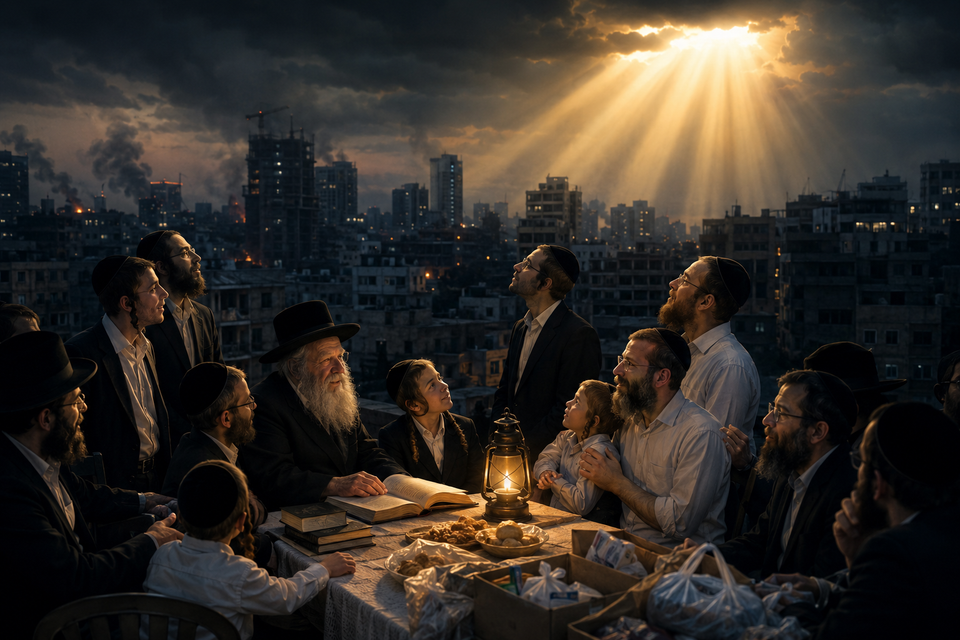
It is a serious question, and it touches something real in many Jews: if the State of Israel were somehow to collapse before Moshiach comes — politically, militarily, or economically — what would become of the Jews living here? Who would protect them? How would they eat, work, and live without a functioning government? Charedim do not wave these concerns away; the fears behind them are real, and they are human. But the Torah looks at the question through a different lens, and that lens changes the entire shape of the answer. Let one thing be clear before we begin: none of what follows is a wish for the State to fall, and none of it is a shrug at the welfare of the millions of Jews who depend on it. Charedim daven every single day for the safety and the sustenance of every Jew alive. The question here is narrower, and deeper: where does a Jew's ultimate security actually rest?
I. No State Was Ever the Source of Our Survival
Begin with the bedrock, because everything else follows from it. From a Torah perspective, the State of Israel — its institutions, its army, its economy — is simply not what holds Am Yisrael in existence. One thing has done that across all of history, and only one: HaKadosh Baruch Hu. "Is He not your Father who made you, who fashioned you and set you firm?" (Devarim 32:6).
And this is not a pious slogan; it is the plainest possible reading of our own past. Am Yisrael has outlived every empire that ever set out to erase it — Mitzrayim, Bavel, Paras, Yavan, Rome — and survived two thousand years of exile with no land, no army, and no sovereignty of any kind. Nations incomparably mightier than the modern state rose, ruled the world, and crumbled into museum exhibits, while a scattered and defenseless people with no power to speak of kept its Torah and kept breathing. The Netzach Yisrael, the Eternity of Israel, has never once depended on the instruments of any single century. A Jew who truly knows that history does not derive his existence from a flag.
II. Where Security Really Comes From
Take the hardest version of the fear first — physical security. The question usually carries an unspoken assumption inside it: that it is the army, and the army alone, standing between the Jewish people and destruction. The Torah's answer is not that armies count for nothing — a Jew is obligated in hishtadlus, and the soldiers who place themselves between Jewish families and those who would murder them are owed genuine, heartfelt hakaras hatov. The Torah's answer is that the army, real as its strength is, is never the actual source of the safety. "These trust in chariots and these in horses," sang Dovid HaMelech, a man who knew the battlefield intimately, "but we invoke the Name of Hashem our God" (Tehillim 20:8). "If Hashem does not guard the city, the watchman keeps his watch in vain" (Tehillim 127:1).
All through Tanach, Klal Yisrael was rescued again and again at moments when, by every earthly calculation, it should have been finished — and the Guardian of Israel, who "neither slumbers nor sleeps" (Tehillim 121:4), is not a different Guardian now that the century has changed. The IDF's successes, too, are ultimately His; its strength is real, but it is borrowed strength. Were the human instruments ever to fail, the One who lent them their strength in the first place would still be exactly where He has always been. This is how the Gemara chooses to close the entire Maseches Sotah: "ein lanu al mi l'hisha'en ela al Avinu shebaShamayim" — we have no one upon whom to lean except our Father in Heaven (Sotah 49b).
III. Where Bread Really Comes From
The same holds for the fear underneath the economy — will people simply go hungry? It is worth asking the question honestly, and now, not only in some imagined future: who feeds us even today? The markets? The banks? The Knesset? Or the One of whom we say, three times every day, "You open Your hand and satisfy the desire of every living thing" (Tehillim 145:16)? The economy is a vessel through which sustenance flows; it has never been the source of the sustenance. Hashem fed an entire nation bread out of the sky, for forty years, in a wilderness where by nature nothing grows at all. "It is in vain that you rise early and sit late... for He provides for His beloved even in their sleep" (Tehillim 127:2) — not that a person's effort is pointless, but that his effort was never quite what was feeding him to begin with. If the familiar channels were one day to fail, a Jew of emunah believes with a full heart that Hashem would open others, exactly as He always has.
IV. Daily Life, and the Strength of the Kehillah
As for the ordinary texture of daily life — how would anything actually function? — the honest answer is that no one knows precisely what Hashem would do, and a Jew is not asked to draw the map in advance. But two things can be said with confidence. The first is that Hashem does not abandon His people; that is the single unbroken constant of all Jewish history. The second is more concrete, and visible right now: the Charedi kehillah is already, to a remarkable degree, a society that takes care of its own. Its chinuch, its chesed, its gemachim, its food and medical and housing networks — an entire scaffolding of mutual responsibility — already run, day in and day out, on the labor and the love of the community itself.
Jews have reorganized their collective life, under conditions infinitely harsher than these, more times than history can even count. There would, of course, be real hardship in any upheaval; no one pretends otherwise, and no one would wish it. But a people that rebuilt itself after the Churban, after the expulsion from Spain, after the ashes of the camps, is not a people whose continued existence hangs on the survival of any one government.
V. What the Eye of Emunah Sees
And here is the deeper layer, the one that quietly reframes the entire fear. Rav Elchonon Wasserman, in his essay on the footsteps of Moshiach, taught that the great trial of the era before the Geulah would be the seduction of Jews by false ideologies — the modern faiths, nationalism prominent among them, that promised a redemption engineered by human hands without any need for Hashem — and that emunah itself would be clarified and purified precisely through the failure of those ideologies to deliver what only Hashem can give. To the eye of emunah, then, the humbling of any human system that ever presented itself as Israel's true savior is not, in the end, chaos. It is the slow stripping-away of an illusion, so that a people might finally lift its eyes back up to the only One who was ever truly holding it.
But let this be said as plainly as it can be said: this is not a hope for catastrophe, and not a wish for a single Jew anywhere to suffer so much as an hour of fear. It is something far quieter than that — the simple refusal to mistake the vessel for the Source, and the steady, unshakable confidence that whatever may befall Klal Yisrael, the Hand beneath us never once lets go.
VI. The Collapse of Falsehood Is the Birth of Truth
So what would happen, if the State were to fall before Moshiach? It would be painful. It would be frightening. But to a Jew of emunah it would not be the end of hope — because his hope was never ultimately deposited there in the first place. The Jew who has truly internalized ein lanu al mi l'hisha'en ela al Avinu shebaShamayim is not living in denial; he simply knows where the floor of his existence actually is, and it was never under any Knesset.
We do not pray for upheaval. We pray, as we have always prayed, for the safety and the bread and the peace of every one of our brothers and sisters, without exception. But we also know, with everything in us, that the One who carried us out of Mitzrayim, through the wilderness, and across two thousand years of exile has not grown one degree weaker, and has not for one moment forgotten where His children are. Whatever comes, He remains. And in the end, He is the only security there has ever truly been.
May Hashem watch over all His people in safety, may no Jew know fear or want, and may He bring the true redemption that needs no illusions to lean upon — bimheirah b'yameinu, amen.
Sources
Hashem as the source of all survival
- Devarim 32:6 — "Is He not your Father who made you?"; the testimony of Jewish history, having outlived every empire and survived two thousand years of exile without land or army; Netzach Yisrael, the eternity of Israel (Shmuel I 15:29)
Security and sustenance
- Tehillim 20:8 — these trust in chariots and these in horses, but we invoke the Name of Hashem; Tehillim 127:1 — if Hashem does not guard the city, the watchman watches in vain; Tehillim 121:4 — the Guardian of Israel who neither slumbers nor sleeps; Sotah 49b — we have no one to lean upon but our Father in Heaven
- Tehillim 145:16 — You open Your hand and satisfy every living thing; Tehillim 127:2 — that Hashem provides for His beloved even in their sleep; the mann that fed a nation in the wilderness
Emunah before the Geulah
- Rav Elchonon Wasserman, in his essay on Ikvisa D'Meshicha — that the era before Moshiach would test Israel through the false ideologies of the age, and that emunah would be clarified through their failure
The structural relationship to other articles in this series
- "Yes, We See the Miracles" — the Hand of Hashem behind events the world reads only on the surface
- "Charedi View on Protecting Their Cities" — security and emunah held together
- "What Happens to the State When Moshiach Comes?" — the question of human systems in the light of the Geulah