
Does the IDF Put Soldiers in Harm’s Way Because of Political and Legal Pressures?
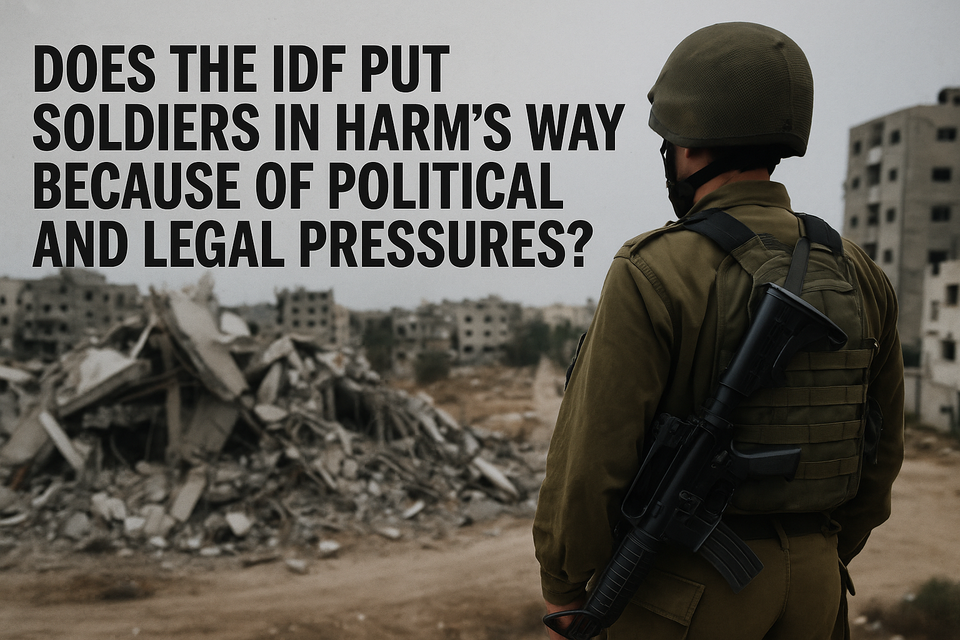
A Brigadier General Says Yes — And the Halachic Implications Are Devastating
One of the most painful truths emerging from the post-October 7 war — and increasingly admitted by senior IDF officers themselves — is that Jewish soldiers are dying because of restrictions the army has voluntarily imposed on its own operations. Not restrictions required by international law. Not restrictions necessary for genuine pikuach nefesh of Palestinian civilians. Restrictions imposed by the Military Advocate General's office, the Attorney General's office, and a culture of legal-political constraint that has, in the words of a former Gaza Division combat commander, "gotten out of control."
This is no longer a Charedi accusation. It is now the public testimony of senior reserve officers who served at the highest operational levels of the war. And the halachic implications are devastating — because if the State's military framework is itself the cause of Jewish soldiers being killed unnecessarily, then every argument that frames participation in that framework as a halachic imperative collapses on its own evidence.
I. The Documented Reality: A Brigadier General Speaks
On August 25, 2025, Arutz Sheva published a detailed interview with Brigadier General (res.) Oren Solomon — former director of combat in the Gaza Division during the Swords of Iron war, and previously a senior official in the Prime Minister's Office. Solomon's testimony is on the record, in print, and unmistakable.
Solomon described how, beginning with Operation Cast Lead (2008–2009), the IDF began embedding legal advisers in operational planning teams at every level — including fire control and weapons selection. "This was unprecedented before Operation Cast Lead," he said. "In this current war, however, the weight of legal counsel has increased far beyond what is necessary, in my view, to the point where it jeopardizes the security of our forces and obstructs the attainment of the war's strategic goals."
His specific examples, drawn from real-time wartime decisions, are devastating:
"If intelligence identifies a terrorist residing in a certain house, the target is passed to the Air Force planning teams. There, a lawyer may rule that a one-ton bomb is prohibited because, although it would kill the terrorist, the blast radius might damage adjacent homes. Instead, they insist on using a smaller bomb, half-ton or even quarter-ton, or they stipulate that the house may only be attacked once all neighboring homes have been evacuated. This requires additional intelligence collection through the Shin Bet and Military Intelligence, along with phone warnings to residents. Inevitably, by the time these measures are completed, the terrorist has already fled. Thus, we lose numerous targets."
Most damningly, Solomon stated that even on October 7th itself — while Hamas was massacring, raping, and abducting Jews in their homes — "orders were issued as if it were still October 6th." The legal framework did not adapt to the reality of the largest massacre of Jews since the Holocaust. The lawyers in the Kirya continued issuing their constraints during a slaughter.
Solomon's summary metaphor, in the published interview, is unsparing:
"The legal guidelines are shackling our forces. It is as if a boxer has been bound hand and foot, blindfolded, forced to hop on one leg, and still expected to win."
He added that international law would actually permit substantially broader use of force than the MAG authorizes — meaning the IDF has voluntarily restricted itself beyond what global legal standards require. The result, he says, is that "we miss dozens, hundreds, even thousands of targets" — and Jewish soldiers die in operations that would not have been necessary if the targets had been struck when first identified.
This is not Charedi rhetoric. This is the published testimony of a Brigadier General who commanded the Gaza Division. The source is Arutz Sheva, a Religious Zionist publication. The article is dated August 25, 2025, headline: "Former IDF dir. of combat: This is how Military Advocate General endangers our soldiers."
II. The Torah's Position: V'Chai Bahem
The Torah's foundational principle on this question is one of the clearest in halacha:
"וּשְׁמַרְתֶּם אֶת חֻקֹּתַי וְאֶת מִשְׁפָּטַי אֲשֶׁר יַעֲשֶׂה אֹתָם הָאָדָם וָחַי בָּהֶם" — "And you shall keep My statutes and My laws, which a person shall perform and live by them" (Vayikra 18:5).
The Gemara in Yoma 85b — and codified by the Rambam in Hilchos Yesodei HaTorah perek 5 — derives from this verse the foundational principle of pikuach nefesh docheh es kol haTorah kulah: the saving of a Jewish life overrides virtually the entire Torah. The exceptions are exactly three (Sanhedrin 74a): avodah zarah, gilui arayos, and shefichus damim — idolatry, illicit relations, and the murder of an innocent Jew. Everything else — every mitzvah, every chumra, every halachic preference — yields before the obligation to save a Jewish life.
This is the framework against which the IDF's voluntary legal restrictions must be evaluated. Are Jewish lives being lost — Jewish soldiers, sometimes Jewish civilians — because of restrictions the army imposes on itself for non-pikuach-nefesh reasons? If Solomon's documented testimony is accurate — and it has not been denied by the IDF Spokesperson, the MAG's office, or any official authority — then the answer is yes.
The halachic implication is sharp. A framework that voluntarily allows Jewish soldiers to die in order to satisfy diplomatic, legal, or reputational concerns is operating against the Torah's foundational principle of v'chai bahem. It is making the calculation the Torah forbids: prioritizing values below pikuach nefesh — even legitimate values like reducing civilian casualties — over the lives of Jewish fighters whose protection is non-negotiable.
III. How Torah Frames War
The Torah does not pretend war is bloodless. It provides a halachic framework for how war is conducted, codified in Devarim 20:10–13 and developed by the Rambam in Hilchos Melachim u'Milchamoseihem perek 6. The framework includes:
- Offering peace before war (Hilchos Melachim 6:1): no Jewish war, even a milchemes mitzvah, begins without first offering terms. The offer must be authentic. The terms must include acceptance of basic moral law (the sheva mitzvos b'nei Noach) and submission to Jewish sovereignty.
- Acceptance of terms creates obligations on both sides (Hilchos Melachim 6:1): if the enemy accepts, no war is fought. If they reject, the framework moves to the next stage.
- Conduct in war (Hilchos Melachim 6:7): even during siege, the encircling forces leave one side open for those who wish to flee. This is not unlimited compassion — it is a specific halachic provision for non-combatants.
- No wanton destruction (Hilchos Melachim 6:8–10): the prohibition of bal tashchis extends to wartime. Fruit trees may not be cut down for no operational reason.
This is a real framework with real moral weight. But notice what it does not do. It does not subordinate Jewish soldiers' lives to legal advisers' interpretations of proportionality. It does not allow the deaths of Jewish fighters in order to satisfy media concerns or international reputation. It does not require the IDF to use weapons less suited to neutralizing terrorists when more suited weapons are available, simply because lawyers cannot certify zero collateral damage in advance.
The Torah's framework for war is decided by Torah authority — the Sanhedrin, the king, the navi — and applied by Torah-observant commanders operating within halachic categories. The framework Solomon describes is decided by secular legal advisers operating within international-law categories that, in his own testimony, are voluntarily stricter than international law itself requires.
These are two different frameworks. One sustains Jewish soldiers' lives within a halachic structure. The other costs Jewish soldiers' lives within a framework no halachic authority ever ratified.
IV. The Halachic Problem With Secular Legal Authority Over War
The article on milchemes mitzvah in this series, and the article on Jewish kings and the Sanhedrin, both made the structural point: the State of Israel does not possess the halachic apparatus — no Sanhedrin, no king, no Urim v'Tumim — to authorize war within the Rambam's halachic categories. The Solomon testimony adds a practical dimension to that structural argument.
When the Military Advocate General — a secular legal officer trained in international humanitarian law, not in halacha — decides which targets the IDF may strike and which weapons it may use, the question of what framework actually governs Jewish soldiers' lives in combat is being answered by a body the Torah never appointed and never authorized.
This is the deeper problem. Even if one accepts the State's authority for the purposes of pikuach nefesh (and the Charedi gedolim have always accepted the obligation of every Jew to participate in genuine pikuach nefesh of immediate danger), the standing institutional framework through which life-and-death decisions are routed in the IDF has no halachic standing. The decision to lose targets, to use smaller weapons, to evacuate neighbors before strikes, to provide humanitarian aid to populations that refused to leave — these decisions are being made by people the Torah did not appoint, applying values the Torah does not endorse, in ways that according to Solomon's testimony, result in the deaths of Jewish soldiers.
This is not an abstract halachic concern. It is the live reality on the ground, attested by a senior reserve commander who served in the most operationally significant theater of the war.
V. This Affects Every Torah Jew — Not Only Charedim
The Charedi world has been making the structural critique for seventy-eight years. The post-October 7 testimony from Religious Zionist–adjacent voices like Solomon — and from countless reservists, military families, and "Wives of Soldiers for the Sanctity of the Camp" type organizations — shows that the critique is now becoming impossible to ignore even within the Religious Zionist community itself.
This is no longer a question of whether the IDF's framework systematically endangers its religious soldiers. The framework does. The testimony documents it. The reservists' families know it. The question is whether the Religious Zionist establishment will continue to treat the framework as sacred, even as its own children pay the price.
The Charedi position has always been: we daven for every soldier, we run Hatzalah and Zaka to every battlefield, we feed soldiers' families, we mourn every fallen Jew — but we will not grant halachic legitimacy to a framework that systematically endangers its own fighters for non-halachic reasons. That position looked harsh to many in 1955, in 1973, in 2005, and in 2014. After October 7 and the Solomon testimony, it looks something like prophetic.
VI. A Question for the Religious Zionist Community
We have written before in this series about the warmth we feel for the Religious Zionist community and the difficulty of the questions we ask of it. We ask this one with the same warmth:
If the framework you have committed your sons to — the framework you have buried sons for, the framework whose theology you have taught your grandchildren to revere — is now being identified, by its own senior commanders, as systematically endangering the very soldiers you sent into it, what does halacha require you to conclude?
If the Military Advocate General was, in October 7's first hours, restricting IDF responses while Jews were being slaughtered — and if subsequent investigations bear this out — how does the theology of "the IDF is the army of Hashem" survive the documentation?
If the framework knowingly accepts the loss of "dozens, hundreds, even thousands" of targets — and the deaths of Jewish soldiers that result from those losses — for the sake of legal abstractions that the same framework's commanders say go beyond what international law requires — is this the framework worth swearing religious devotion to?
We are not asking these questions to be cruel. We are asking them because every Charedi parent davening for the wounded, every Charedi family hosting reservists' wives for Shabbos meals, every Charedi yeshiva running tefillah groups for soldiers and hostages, is asking the same questions in their own hearts. The Solomon testimony is not a Charedi document. It is a Religious Zionist publication's interview with a Religious Zionist–adjacent senior officer. The Religious Zionist establishment is now generating the same critique from inside its own ranks. The question is whether the community will hear it.
VII. The Documented Charedi Position
The documented Charedi halachic position on the State's military framework — set out by the Chazon Ish in Kovetz Igros, by the Brisker Rav in Uvdos V'Hanhagos L'Beis Brisk (Vol. 2, siman 140) and Peninei Rabbeinu HaGriz (p. 148), by the Satmar Rav in Vayoel Moshe, by Rav Elchonon Wasserman in Kovetz Maamarim and Ikvesa D'Meshicha, by Rav Shach in Michtavim u'Maamarim, and most recently by Rabbi Dov Lando shlita's November 2024 letter — has not changed.
The position is structural, not vindictive. A Torah-observant Jew cannot grant halachic standing to a framework that operates outside Torah authority and systematically subordinates Jewish lives to non-halachic values. The conclusion does not depend on whether the framework is well-intentioned. It does not depend on whether individual soldiers within it are heroic (they are). It depends on whether the standing institutional structure of the IDF — its chain of command, its legal advisory apparatus, its political oversight — operates within halacha. The Charedi gedolim have ruled, consistently across four generations, that it does not.
Solomon's testimony does not require the Charedi position to change. It requires the secular and Religious Zionist establishments to grapple with what their own commanders are now saying about the framework they have asked their sons to serve in.
VIII. The Lives Are in Hashem's Hands — Not Lawyers' Hands
The Charedi response to every Jewish casualty in this war has been what it has always been: Tehillim, tefillah, teshuvah, increased Torah, chesed to the bereaved, and the recognition that every Jewish life is in Hashem's hands. Solomon's testimony reinforces what the Torah always taught: when human institutions try to manage the question of life and death without Torah guidance, the result is often that life is sacrificed to abstractions that the Torah would never have endorsed.
The Rambam ruled in Hilchos Melachim 6:7 that even in a halachic siege, one side of the city is left open for those who wish to flee. The Torah's framework knows how to balance protection of Jewish soldiers against humane treatment of non-combatants — but it does the balancing under Torah authority, with Torah judgment, in the name of Torah values. The IDF's framework attempts the same balancing, under secular legal authority, with secular legal judgment, in the name of values that are sometimes legitimate and sometimes — as Solomon now testifies — voluntarily stricter than even international law requires.
A Jewish soldier's life is sacred. It is sacred according to halacha. It is sacred according to every framework that calls itself moral. When that life is lost because of restrictions the framework imposed on itself for non-halachic reasons, the loss is not a tragedy of war. It is a tragedy of a framework operating outside the only authority that has the standing to balance these questions correctly.
Until the proper framework is restored — until shofteinu k'varishonah, our judges as at first, return, and the Sanhedrin sits again, and Mashiach reigns — the Charedi position holds. We daven for every soldier. We mourn every loss. We refuse to grant halachic legitimacy to a framework that costs Jewish lives in service to abstractions no Torah authority ever ratified.
Our lives are in the hands of Hashem. Not in the hands of lawyers in the Kirya. May He return us to the framework He commanded, bimheirah b'yameinu.
Sources
Primary testimony
- Israel National News / Arutz Sheva, "Former IDF dir. of combat: This is how Military Advocate General endangers our soldiers" by Shimon Cohen (August 25, 2025) — interview with Brig. Gen. (res.) Oren Solomon, former director of combat in the Gaza Division and former senior official in the Prime Minister's Office. Full text available at israelnationalnews.com/news/413827
Primary halachic sources
- Vayikra 18:5 — "v'chai bahem"
- Devarim 20:10–13 — the conduct of war
- Talmud Bavli, Sanhedrin 74a — the three exceptions to pikuach nefesh docheh
- Talmud Bavli, Yoma 85b — the derivation of pikuach nefesh from v'chai bahem
- Rambam, Mishneh Torah, Hilchos Yesodei HaTorah perek 5 — codification of pikuach nefesh
- Rambam, Mishneh Torah, Hilchos Melachim u'Milchamoseihem perek 5 — categories of war
- Rambam, Mishneh Torah, Hilchos Melachim u'Milchamoseihem perek 6 — conduct of war, offering of peace, the open side of a siege
- Shulchan Aruch, Yoreh Deah 157 — codification of pikuach nefesh in halacha
Documented Charedi halachic position
- Kovetz Igros, Chazon Ish, Vol. 1, p. 97
- Chazon Ish, Orach Chaim, Hilchos Eiruvin, siman 114
- Uvdos V'Hanhagos L'Beis Brisk, Vol. 2, siman 140 — the Brisker Rav (Rav Yitzchok Zev Soloveitchik zt"l)
- Peninei Rabbeinu HaGriz, p. 148
- Vayoel Moshe, Rabbi Yoel Teitelbaum (Satmar Rav), Maamar Shalosh Shevuos
- Kovetz Maamarim and Ikvesa D'Meshicha, Rabbi Elchonon Wasserman Hy"d
- Michtavim u'Maamarim, Rabbi Elazar Menachem Man Shach zt"l, Vol. 1
The Chazon Ish – Ben-Gurion meeting (October 20, 1952)
- Yitzchak Navon's recorded account, published in his memoirs
- World Mizrachi, "The Chazon Ish, Ben-Gurion and Rav Tzvi Yehudah" (March 2023)
- Yeshiva World News, "70 Yrs Ago Today: What Happened At The Historic Meeting Of The Chazon Ish And Ben-Gurion?" (October 2022)
The November 2024 Lithuanian Roshei Yeshiva letter
- Israel National News, "Haredi leaders warn against Haredi IDF service tracks" — Rabbi Dov Lando shlita's signed letter