Do Charedim Value Living in Eretz Yisrael Even If They Are Not Zionists?
It looks like a contradiction: hundreds of thousands of visibly frum families pour their lives into Yerushalayim, Bnei Brak, and Tzfas — and most of them will not call themselves "Zionists." The resolution is simple once it is named. Eretz Yisrael is a mitzvah, beloved and eternal; Zionism is a modern movement. One can give one's whole life to the first without signing on to the second.
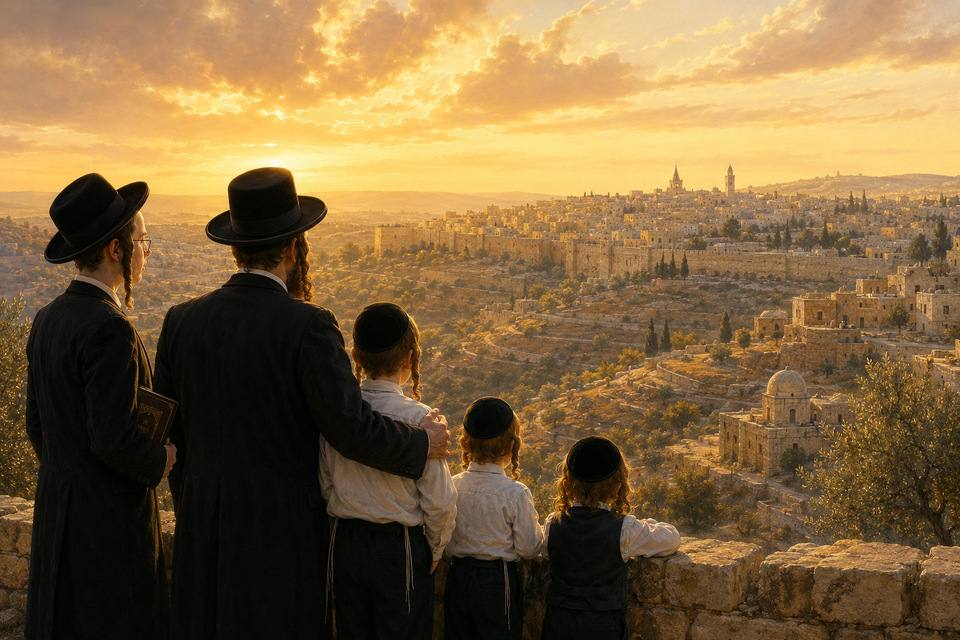
Walk through Mea Shearim, Bnei Brak, or the hills of Beitar, and you will see a community that has built its entire existence on the soil of Eretz Yisrael — yeshivos, kollelim, generations born and raised in the shadow of the Kosel. And then you will hear that most of these Jews do not describe themselves as Zionists, and the outsider is baffled. How can you love a land this much, live on it this devotedly, and reject the word?
The bafflement dissolves the moment one distinguishes two things that are constantly, and carelessly, fused: the Land, which Torah has cherished for three thousand years, and Zionism, a political movement not much older than a century. Charedim embrace the first with their whole being. It is the second — a modern ideology, in its origins largely secular — about which they keep their distance. This is not coldness toward Eretz Yisrael. It is precision about what their love is for.
I. Begin Here: Charedim Love Eretz Yisrael
Before anything else, let the central fact be stated plainly, because the whole question rests on it: the love of Charedim for Eretz Yisrael is total, and it is ancient.
A Jew faces Yerushalayim three times a day in Shemoneh Esrei. He begs, in every single weekday Amidah, "v'sechezenah eineinu b'shuvcha l'Tzion" — that our eyes behold Hashem's return to Tzion. He prays for the rebuilding of Yerushalayim in his bentching after every meal. He ends the Pesach seder and the Ne'ilah of Yom Kippur with the same cry his ancestors cried in every exile: "L'shanah haba'ah b'Yerushalayim." This is not borrowed from any modern movement; it is woven into the marrow of Jewish life and has been since we first wept by the rivers of Bavel.
And the Torah's own valuation of the Land could not be stronger. The Gemara teaches: "One should always dwell in Eretz Yisrael… for whoever dwells in Eretz Yisrael is like one who has a God, and whoever dwells outside the Land is like one who has no God" (Kesuvos 110b). Its very air, Chazal say, makes one wise — avira d'Eretz Yisrael machkim (Bava Basra 158b). Rabbi Yehuda HaLevi, centuries before any "ism," sang "Libi b'mizrach va'ani b'sof ma'arav" — "my heart is in the East and I am at the edge of the West" — and devoted the climax of the Kuzari to the unique sanctity of the Land as the place of prophecy and closeness to Hashem. The Jewish love of Tzion is not a political position. It is a heartbeat. No one needs to teach a Charedi Jew to love Eretz Yisrael; he has been doing it, in his tefillos, his learning, and his longing, his entire life.
II. The Land Is a Mitzvah; Zionism Is a Movement
So if the love is total, where is the line? It runs exactly between a mitzvah and a movement — and the distinction is the whole answer.
The Ramban, in his celebrated addition to the Rambam's Sefer HaMitzvos (Asei 4), rules that settling Eretz Yisrael and not abandoning it to others is a positive commandment binding in every generation — "we are commanded to take possession of the Land… and not to leave it in the hands of others, or desolate." This is yishuv ha'aretz, a mitzvah of the Torah. It has nothing to do with flags, anthems, or the politics of the nineteenth and twentieth centuries. A Jew fulfills it by living on the Land and building a Torah life upon it — which is precisely what Charedim have done, in unbroken continuity, for as far back as Jewish memory reaches.
Zionism is something else entirely. It is a specific modern movement, born in the late 1800s, which sought to solve the crisis of European Jewry through secular national self-determination — and which, in significant measure, conceived of Jewish identity in national rather than religious terms, sometimes explicitly as a replacement for the Torah-defined peoplehood that preceded it. One can wholeheartedly keep the mitzvah while declining the movement — and that, in a sentence, is the Charedi position. The love is for the Land and its kedushah; the reservation is about an ideology that arose to reinterpret what being a Jew even means.
III. The Old Yishuv: Here Long Before Herzl
The clearest proof that the love of the Land was never about Zionism is chronological: the Torah community was living in Eretz Yisrael, devotedly, for generations before political Zionism existed at all.
In 1777, a wave of the Chassidic world — led by Rav Menachem Mendel of Vitebsk and Rav Avraham of Kalisk, of the school of the Baal Shem Tov — made aliyah to Tzfas and Teveria, drawn by nothing but the yearning to live in the land of the Shechinah. Beginning around 1808, the Perushim, talmidim of the Vilna Gaon, came in successive groups and rebuilt the Ashkenazi kehillah of Yerushalayim, reviving a Torah presence in the Old City that had lain in ruins. Together with the long-established Sephardic community, they formed what came to be called the Old Yishuv — religious Jews living across the four holy cities of Yerushalayim, Tzfas, Teveria, and Chevron, many in real poverty, sustained by the chalukah of European donations. As the community grew, it spread beyond the walls of the Old City — Mea Shearim was founded in 1874 — and built, neighborhood by neighborhood, the Torah Yerushalayim that still stands today.
Why did they come? Not for a state, and not for a movement — neither existed. They came to daven at the Kosel, to fulfill the mitzvos that can only be kept on the Land, to breathe its air and raise children in its holiness. They were Charedi, and they were here more than a century before Theodor Herzl published Der Judenstaat in 1896. The notion that love of Eretz Yisrael arrived with Zionism has the history exactly backwards.
IV. So Why the Hesitation Toward the Word "Zionism"?
If Charedim love the Land and keep the mitzvah of living on it, why hold the label at arm's length? For several reasons, each rooted not in indifference to Eretz Yisrael but in loyalty to Torah.
The largely secular origins of the movement. The founders of political Zionism were, in the main, far from Torah. Herzl himself spoke no Hebrew, had no Jewish education, and conceived the whole project in secular terms. So distant was his early thinking from any Torah framework that, around 1893 — before he turned to the idea of a Jewish state — he briefly entertained a scheme for the mass conversion of Austrian Jewry to Catholicism, imagining a public baptism in Vienna as a "solution" to antisemitism. Historians regard it as a desperate idea he soon abandoned; but that the eventual father of the movement could even contemplate it tells you how far its origins stood from the beis medrash. Ben-Gurion, for his part, openly understood Jewishness as a national rather than religious identity and made no secret of his disdain for the rabbinate. A movement built on such foundations could not become the vessel of a Torah Jew's deepest loyalties — even one who shared its wish to see Jews living safely in the Land.
Theological concern about forcing the end. Much of the Torah world held that the full national restoration of Klal Yisrael belongs to the Geulah, brought by Moshiach, and viewed the establishment of a sovereign secular state in its place as, at best, premature. Many pointed to the Gemara's shalosh shevuos — the Three Oaths (Kesuvos 111a; Shir HaShirim Rabbah) — by which Israel was sworn not to return to the Land en masse by force and not to rebel against the nations, and the nations sworn not to oppress Israel excessively. The precise halachic weight of these oaths is itself a subject of dispute among the poskim — the Satmar Rav built his entire opposition upon them in Vayoel Moshe, while other Gedolim weighed them differently — but as a hashkafic concern they shaped the Charedi wariness of the Zionist project profoundly.
The simple separation of mitzvah from movement. Underlying it all is the cleanest point of the three: one need not endorse a political ideology in order to love a land and keep a commandment. Eretz Yisrael is a mitzvah; Zionism is a movement — and conflating the two does a disservice to both. The Charedi declines the label precisely in order to keep the love pure — anchored in Torah and kedushah rather than in the nationalism that borrowed the Land's name.
V. The Gedolim Who Lived the Mitzvah Without the "Ism"
If proof were needed that one can pour out one's life for Eretz Yisrael without being a Zionist, the lives of the Gedolim supply it. The greatest non-Zionist authorities of the last century did not merely permit living in the Land — they chose it, and built it.
Rav Yosef Chaim Sonnenfeld, the towering rav of the Eidah HaCharedis, was among the most uncompromising opponents of political Zionism and, at the very same time, one of the most ardent lovers of Eretz Yisrael, who spent his life raising generations of Torah Jews in Yerushalayim. The Chazon Ish settled in Bnei Brak in 1933 and made it, from a small town, into a world center of Torah — wary of secular Zionism to his core, yet a profound believer in the sanctity of the Land and in living upon it. Rav Shlomo Zalman Auerbach lived his whole life in Shaarei Chesed in Yerushalayim, his love for the Land famous among his talmidim, without ever adopting Zionist ideology. Rav Yosef Shalom Elyashiv, the posek hador, lived in Mea Shearim and breathed the kedushah of the city until his final years. None of them was a Zionist. Every one of them was a lover and a builder of Eretz Yisrael. Their lives are the standing refutation of the claim that the two must go together.
VI. The Proof Is in the Building
And what was true of the Gedolim is true of the community they led. The modern Charedi world is itself the largest living demonstration of how deeply Torah Jews value Eretz Yisrael.
Hundreds of thousands of Charedim have made their homes on the Land — quietly, with spiritual intent, asking for no recognition. Entire cities — Bnei Brak, Modi'in Illit, Beitar Illit — and great swaths of Yerushalayim are thriving Torah centers raised on love for Eretz Yisrael. Thousands of yeshivos, kollelim, seminaries, and mikvaos have been built across its hills and valleys, very often with real mesirus nefesh and not a particle of political motive. They may not fly flags or mark Yom HaAtzmaut. But they are here — living, learning, davening, and raising Jewish families on holy soil, by the hundreds of thousands, generation after generation. Devotion is measured in lives lived, not in slogans declared — and by that measure, the Charedi attachment to the Land is beyond serious dispute.
VII. The Bottom Line
So — do Charedim value living in Eretz Yisrael, even though they are not Zionists?
Immensely, and without reservation. To the Charedi Jew, the Land is not a national project but a place of holiness — the home of the Shechinah, the one soil on which whole categories of mitzvos can be fulfilled, the ground toward which he turns his heart three times a day. His loyalty is to Torah rather than to any ideology; his hope is in Moshiach rather than in any government; but his feet, his home, and his children's cradle are planted firmly in the Land that Hashem gave as His eternal gift to His people.
And that love needs no modern name. It is not Zionism at all — it is something far older and far deeper: the love of Tzion that has beaten in the Jewish heart since the rivers of Bavel, the love of the navi and the paytan, of the talmidim of the Gra and the Baal Shem Tov, of Rav Sonnenfeld and the Chazon Ish. The Charedi world does not need to borrow a century-old word to express a three-thousand-year-old longing. It simply lives it — on the Land, in the Torah, with its whole heart.
May we soon merit to see Tzion rebuilt in its full glory, the Shechinah returned to its place, and all of Klal Yisrael gathered home — bimheirah b'yameinu, amen.
Sources
The love itself — Torah's valuation of the Land
- Kesuvos 110b — "whoever dwells in Eretz Yisrael is like one who has a God"; the supreme value of living on the Land
- Bava Basra 158b — avira d'Eretz Yisrael machkim, "the air of Eretz Yisrael makes one wise"
- The tefillos — facing Yerushalayim three times daily; "v'sechezenah eineinu b'shuvcha l'Tzion"; the rebuilding of Yerushalayim in bentching; "L'shanah haba'ah b'Yerushalayim" — the love of Tzion woven through Jewish life for millennia
- The Kuzari (Rabbi Yehuda HaLevi), Maamar 2 and 5, and his poems of longing ("Libi b'mizrach") — the unique sanctity of the Land, centuries before any modern movement
The Land as a mitzvah, distinct from the movement
- Ramban, Hasagos to the Sefer HaMitzvos, Positive Commandment 4 — the mitzvah of yishuv ha'aretz, to settle and not abandon the Land, binding in every generation — the classic source separating the commandment of living on the Land from any political program
- The distinction between love of Eretz Yisrael and Zionism as a movement is developed by Rav Shimon Schwab in his collected essays (Feldheim) — cited for the theme; the precise essay title worth confirming against the volume
The Old Yishuv — here before Zionism
- The Chassidic aliyah of 1777 (Rav Menachem Mendel of Vitebsk and Rav Avraham of Kalisk) to Tzfas and Teveria; the aliyah of the Perushim, talmidim of the Vilna Gaon, from around 1808, rebuilding the Ashkenazi kehillah of Yerushalayim — documented history; works such as Kol HaTor are associated with this circle, though that text's provenance is itself debated, so the aliyah is rested on the historical record rather than on it
- The Old Yishuv in Yerushalayim, Tzfas, Teveria, and Chevron, sustained by the chalukah; the expansion beyond the Old City walls (Mishkenos Sha'ananim, 1860; Mea Shearim, 1874) — correcting the working draft's "1832," which predates the first neighborhoods outside the walls by a generation
- Theodor Herzl published Der Judenstaat in 1896 — more than a century after the Chassidic and Perushim aliyos
The secular origins of the movement
- Herzl's pre-Zionist idea (c. 1893) of a mass conversion of Austrian Jewry to Catholicism — documented across multiple histories (e.g., Simon Schama, The Story of the Jews); presented as an early notion he soon abandoned, not his mature position, and not tied to the unverifiable specific diary date in the working draft
- David Ben-Gurion's conception of Jewish identity in national rather than religious terms, and his documented disdain for the rabbinate
The theological concern
- The shalosh shevuos — the Three Oaths — Kesuvos 111a and Shir HaShirim Rabbah 2:7; centrally the basis of the Satmar Rav's opposition in Vayoel Moshe, with other poskim weighing their halachic force differently — treated at length in our dedicated Three Oaths article; the "Ohr Sameach, end of Hilchos Melachim" citation in the working draft is left aside as unconfirmed
The Gedolim who lived the mitzvah without the ideology
- Rav Yosef Chaim Sonnenfeld (Eidah HaCharedis; HaIsh Al HaChomah); the Chazon Ish (Bnei Brak from 1933; Pe'er HaDor — the Chazon Ish's biography); Rav Shlomo Zalman Auerbach (Shaarei Chesed; Halichos Shlomo and the testimony of his talmidim); Rav Yosef Shalom Elyashiv (Mea Shearim) — all opponents or non-adherents of Zionist ideology, all lovers and builders of Eretz Yisrael (some biographical source titles in the working draft are presented as documented life-facts rather than verified citations)
The structural relationship to other articles in this series
- "Is It a Mitzvah to Live in Eretz Yisrael?" — the halachic foundation of yishuv ha'aretz
- "What Is the Torah View on Nationalism?" — the distinction between Torah peoplehood and secular nationalism
- "The Three Oaths" — the shalosh shevuos in depth
- "Why Don't Charedim Celebrate Yom HaAtzmaut?" and "The Charedi View of the Founding of the State" — the reservations about the movement and the state, treated directly