
Do Charedim Contribute to Israeli Society in Other Ways Besides Paying Taxes?
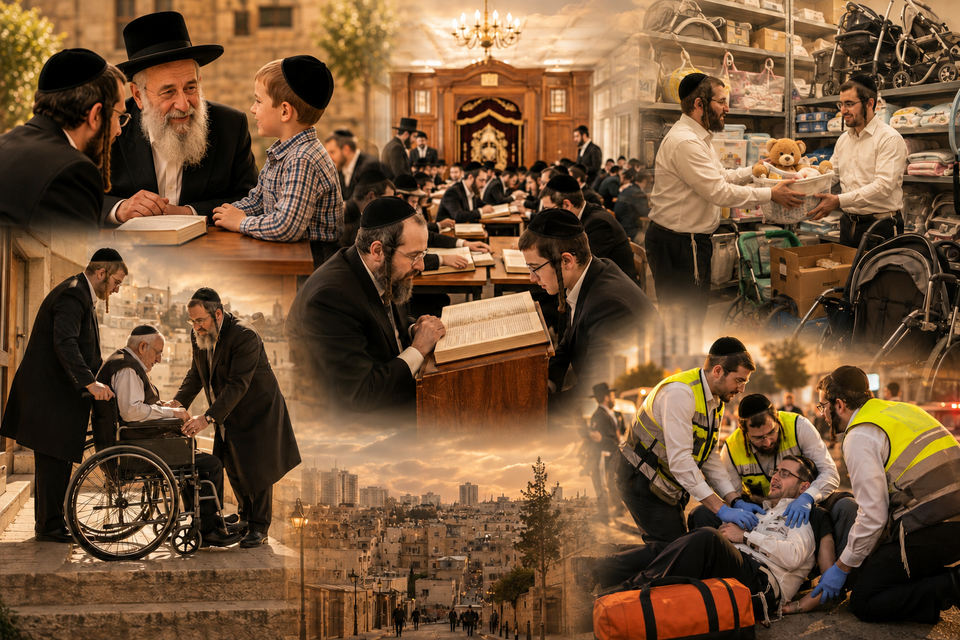
Yes — deeply, constantly, and almost entirely off the radar. The public argument about the Charedi "contribution" has been narrowed to two numbers: how many enlist, and how much income tax is paid. Measured by that thin yardstick, a Torah community can be made to look like a taker. Widen the lens by even an inch and the opposite comes into view — one of the most giving, self-sustaining, and least burdensome populations in the country, much of whose giving flows quietly to every Israeli, religious or not.
Here is the part the headlines never reach. Set aside Torah learning entirely — the spiritual contribution we will touch on only briefly — and the practical Charedi contribution to the State is still enormous. It simply happens in places a news camera rarely goes: a beis din at midnight, a free-loan fund run out of a living room, a wheelchair delivered to a stranger's door before dawn.
I. The Foundation, Stated Briefly
It must be said once, even in an article devoted to the practical, that the Torah world regards limud haTorah itself as a national service of the first order — "If not for My covenant [of Torah] day and night, I would not have set the laws of heaven and earth" (Yirmiyahu 33:25). The full case for that is made elsewhere in this series and will not be repeated here. The point of this article is the one that even a reader who sets that conviction completely aside cannot honestly dispute: beyond the beis medrash, the Charedi community carries a staggering amount of the practical and human weight of Jewish life in Israel.
II. The Halachic Infrastructure Nobody Budgets For
Every city, town, and neighborhood with a Charedi presence runs, largely on Charedi shoulders, an entire apparatus of communal life that the rest of the country quietly depends on. Rabbanim, dayanim, and poskim shoulder the responsibility for kashrus supervision, the upkeep of eruvin, the operation of mikvaos, the halachic handling of marriage and divorce, the work of the chevra kadisha in burying the dead with dignity, batei din that resolve monetary disputes without ever touching a state courtroom, and the endless, unpaid counsel that holds families and young people together through their hardest hours.
Much of this is done around the clock and without compensation, and very little of it stops at the community's own borders. A secular Jew who wants kosher food, a Jewish burial, a halachically valid marriage, or a quiet beis din to settle a dispute relies on the same infrastructure — built, staffed, and sustained by the Torah community. This is a vast public service rendered at almost no cost to the public purse. Were it to vanish tomorrow, the State would have to construct and fund the whole of it from scratch.
III. The Gemach Economy: A Parallel System of Kindness
Then there is the gemach — perhaps the single most remarkable institution the Charedi world has given Israel, and one with no real parallel anywhere else. A gemach (from gemilus chasadim, acts of lovingkindness) is a free-loan or free-lending fund run by volunteers, and they exist in Israel in the thousands. A single Charedi neighborhood may run dozens of them.
The scale is hard to overstate. The interest-free money gemachim alone are estimated to hold deposits ranging from around five billion shekels into the tens of billions — an entire parallel lending economy, built on trust and the Torah's prohibition against charging a fellow Jew interest, operating quietly alongside the banks. And the money gemachim are only the beginning. There are gemachim for medical equipment, wedding gowns, baby formula and cribs, furniture and strollers, sefarim, Yom Tov food, children's clothing, and very nearly anything else a family might need and struggle to afford. They lend to anyone who turns up, very often without asking a single question, and in doing so they fill precisely the gaps that a state's social-services budget leaves open — at no cost to that budget at all. To see the heart of Am Yisrael, an older generation used to say, look inside a gemach; that is where ahavas Yisrael stops being a slogan and becomes a wheelchair, a loan, a wedding dress handed to someone who could not have bought one. It is the Torah's instruction lived out in full: "the world is built on chesed" (Tehillim 89:3), and the world stands on gemilus chasadim no less than on Torah and avodah (Avos 1:2).
IV. Chesed on the Front Line
The same impulse, scaled up and professionalized, has produced some of the most important emergency and welfare organizations in the entire country — institutions that serve every Israeli without distinction.
Yad Sarah, founded by the Charedi activist Uri Lupolianski, grew into Israel's largest volunteer organization, lending out wheelchairs, hospital beds, oxygen machines, and medical equipment of every kind free of charge to anyone who needs them — and in the process saving the national health system a fortune it would otherwise have to spend. Ezer Mizion built and runs one of the largest Jewish bone-marrow donor registries in the world, matching donors to patients and saving lives across Israel and far beyond it. Yad Eliezer feeds and supports tens of thousands of struggling families. United Hatzalah, whose volunteer corps draws heavily on the Charedi community, blankets the country with first responders who reach the wounded within minutes. The volunteers of ZAKA perform perhaps the most thankless chesed imaginable — chesed shel emes, the final kindness owed to the dead — recovering and honoring victims with their own hands after every terror attack and disaster, on behalf of the whole nation, asking nothing and able to be repaid by no one. And organizations such as Lev L'Achim and Shuvu pour themselves into education and outreach, much of it directed at immigrant and secular Jewish children who would otherwise have no Jewish education at all.
None of these are "Charedi services for Charedim." They are gifts to the entire State of Israel, founded and staffed disproportionately by the very community so often described as contributing nothing.
V. The Quiet Contribution: Stable Families, Steady Communities
There is a contribution harder to photograph but no less real. The Charedi world builds unusually strong and stable families, with dense networks of mutual support and a deeply ingrained culture of caring for one's own. The result is communities marked by low rates of crime and family breakdown and a high degree of internal self-sufficiency — communities that lean comparatively lightly on the state's social safety net precisely because they catch their own people first. Raising a large, values-rooted, resilient next generation of Am Yisrael is not a burden the country bears; it is an investment in the country's future that the Charedi world makes, at its own expense, every single day.
VI. The Contribution the Headlines Miss
Contribution, in the end, was never only the thing that fits in a tax bracket or an enlistment statistic. It is the wheelchair delivered at two in the morning. It is the interest-free loan that kept a family in its home. It is the dayan who settled a dispute that would otherwise have clogged a court for two years. It is the volunteer at the disaster site, the rav who talked a marriage back from the edge at midnight, the neighbor who quietly baked an extra challah for the family that had none. None of it trends. Most of it is invisible by design, because the people doing it are not looking to be seen.
So the answer to the question is yes — and it is not a close call. Strip away limud haTorah completely, and the Charedi community remains among the most generous and least burdensome populations in the State of Israel. Add the Torah back in — the foundation on which, the Torah itself testifies, the whole world stands — and what emerges is a community that gives this country immeasurably more than it is ever credited for. The numbers will never capture it. But the family helped at 2 AM knows exactly what it received.
May Klal Yisrael always be a people defined by its chesed, may the quiet givers be blessed for the good they do unseen, and may the day come when every Jew recognizes the worth of every other — bimheirah b'yameinu, amen.
Sources
The Torah of chesed
- Avos 1:2 — the world stands on three things: Torah, avodah, and gemilus chasadim
- Tehillim 89:3 — "olam chesed yibaneh," the world is built on kindness
- Sotah 14a — halacha bidrachav, the mitzvah to walk in Hashem's ways by clothing the naked, visiting the sick, comforting mourners, and burying the dead
- Vayikra 19:18 — "v'ahavta l're'acha kamocha"
- Yirmiyahu 33:25 and Nefesh HaChaim, Shaar 4 — on Torah as the sustaining foundation of creation (developed elsewhere in this series)
The institutions of Charedi contribution
- The gemach system — thousands of free-loan and free-lending funds across Israel, with the money gemachim alone estimated to hold deposits ranging from several billion into the tens of billions of shekels
- Yad Sarah (founded by Uri Lupolianski) — Israel's largest volunteer organization, lending medical equipment free of charge
- Ezer Mizion — among the world's largest Jewish bone-marrow donor registries
- Yad Eliezer, United Hatzalah, ZAKA, Lev L'Achim, and Shuvu — welfare, emergency response, chesed shel emes, and education serving Israelis of every background
The structural relationship to other articles in this series
- "How Does Torah Learning Benefit Every Jew?" — the spiritual contribution set aside here
- "Who Benefits More — Charedim or the State?" — the full balance sheet
- "What Is the Charedi View on How Taxes Are Spent by the State?" — what the community gives, against what it receives
- "Do Charedim Have Hakaras HaTov for Those Who Serve?" — contribution and gratitude as a two-way street