Do Charedim Believe They Are the Only Ones with This Task?
No. Charedim Do Not Believe They Alone Are Charged With Preserving the Torah and Bringing the Geulah — and They Do Not Believe They Are a Special Class of "Guardians" Set Above Other Jews. The Torah Is the Inheritance of Every Jew — Morasha Kehillas Yaakov — and Every Jew Who Strives to Keep Torah and Mitzvos in Line With the Mesorah Is One of Us, Fully and Equally. We Are Not Better; They Are Not Worse. The More Jews Who Take Up This Mission, the Greater the Blessing for All of Klal Yisrael. What Matters Most Is Not a Label or a Camp but Serving Hashem Through the Pure Mesorah — Free of the "Isms" and Falsehoods the World Tries to Inject Into the Torah. That Purity, and Nothing Else, Is How We Are Still Here Today
Do Charedim believe they are the only Jews charged with preserving the Torah and bringing the geulah?
No. And it is important to say so clearly, because the sharper articles in this series — on what distinguishes the Charedi position from others — can leave a false impression of exclusivity that the Charedi world does not hold. Charedim do not believe they own the Torah, that they are its appointed guardians, or that they alone carry its mission. They believe that the holy task of keeping and transmitting the Torah must be done in fidelity to the mesorah handed down from Har Sinai — and that any Jew who takes up that task faithfully is fully a partner in it, with no hierarchy and no caste. We are not better, and they are not worse. Every Jew who strives to keep the Torah and its mitzvos in line with the mesorah is one of us — completely. The more Jews who carry this flame, the greater the blessing for all of Klal Yisrael.
This is not a mission of exclusion. It is a mission of inclusion, built on truth. We work through what that means below.
I. The Torah Is the Inheritance of Every Jew
The starting point is a verse every Jewish child learns among the very first words of Torah he is taught:
"Torah tziva lanu Moshe, morasha kehillas Yaakov."
"The Torah that Moshe commanded us is the inheritance of the congregation of Yaakov." (Devarim 33:4)
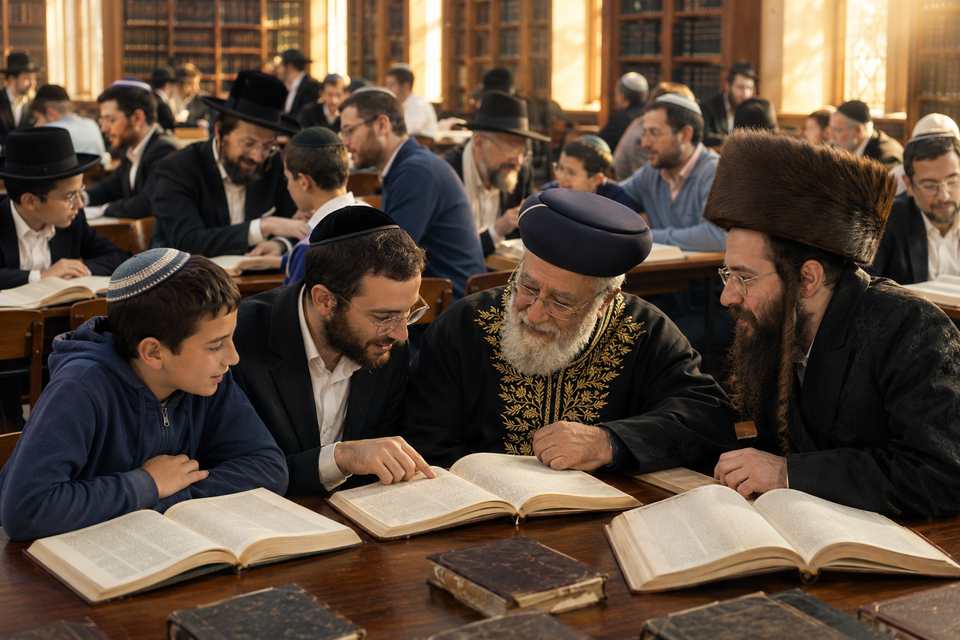
The Torah is a morasha — an inheritance — of the entire congregation of Yaakov, not the private estate of any one group within it. Every Jew, of every background, of every community, who learns Torah and lives it sincerely is an heir to this inheritance and a link in the eternal chain that stretches back to Sinai. The Gemara teaches that this verse establishes the Torah as the birthright of every Jewish child from the moment of birth — it is theirs, by inheritance, simply for being part of Klal Yisrael.
This is the bedrock of the Charedi answer to the question. Because the Torah is the inheritance of every Jew, no Jew and no group can claim to own it or to be its sole guardian. The Charedi world holds the Torah with awe — but it holds it as an inheritance shared with every other Jew, not as private property. Anyone from any background who sincerely takes hold of that inheritance, learning and living the Torah with fidelity to halacha and the mesorah, is a full partner in it. The clothing he wears, the community he comes from, the accent of his Hebrew — none of these determine his share in the inheritance. His sincere grasp of the Torah does.
II. There Is No Special Class of "Guardians"
It would be easy to misread the Charedi commitment to Torah as a claim to be the appointed guardians of it — a special class set above the rest of Klal Yisrael, entrusted with something the others are not. That is not the Charedi belief, and the word "guardian" misleads if it suggests a hierarchy. The truth is both simpler and more beautiful: there is no special class. Any Jew can carry the Torah, and every Jew who carries it faithfully carries it fully.
The Charedi world does pour its energy into the institutions of full-time Torah learning — the yeshivos, the kollelim, the chadarim, the transmission of daas Torah. But it does not do this because it considers itself a superior caste appointed over the Torah. It does it because this is the work in front of it, the way it has received the mesorah and the way it knows to keep it alive — and it would rejoice to see every Jew take up the same work. The point is not "we are the guardians and you are not." The point is "this Torah belongs to all of us, and whoever takes hold of it, faithfully, is holding the very same thing we are."
We are not better, and they are not worse. This must be said plainly, because it is the heart of the matter. A Jew who keeps Torah and mitzvos in fidelity to the mesorah — wherever he comes from, whatever he wears, whatever community he davens in — is not a lesser participant in the inheritance than anyone else. He is one of us, fully and without qualification — not because he has joined a particular camp, but because he is holding the same Torah, faithful to the same mesorah, serving the same Hashem. The labels fall away; what remains is the shared inheritance and the shared service. Every Jew who strives to keep the Torah and its mitzvos in line with the mesorah is one of us — equally, completely, with no hierarchy and no caste.
This is why the framing of "the more the merrier" is not a slogan but a literal truth. The Torah is not diminished by being shared; it is fulfilled by it. There is no fixed number of "guardian" positions to be competed over, no limited supply of the inheritance. The more Jews who take hold of the Torah faithfully, the more fully the inheritance of kehillas Yaakov is realized — and the Charedi world wants nothing more than to see that number grow without end.
III. What Actually Matters — The Pure Mesorah, Free of the "Isms"
If there is no special class of guardians, and every faithful Jew is fully a partner, then what is the one thing the Charedi world holds to be essential? It is not a label, a uniform, or a community. It is the purity of the mesorah itself — serving Hashem as the Torah was given, free of the "isms" and falsehoods that the world keeps trying to inject into it.
This is the real dividing line, and it is not a line between Jews — it is a line between the pure Torah and its adulterations. Across the centuries, the surrounding world has tried, again and again, to "improve" the Torah by mixing it with the ideology of the moment: to make it a Torah of Hellenism, of Enlightenment rationalism, of nationalism, of secular progress, of whatever -ism happened to hold the prestige of the age. Each of these promised to update the Torah, to make it relevant, to align it with the sophistication of the times — and each, where it was accepted, dissolved the very thing it claimed to improve. The Torah does not need the world's isms, and it is not strengthened by them; it is diluted by them, and where it has been diluted, it has not survived.
The one thing that has carried Klal Yisrael through every exile and every empire is the refusal to adulterate the mesorah — the insistence on serving Hashem through the Torah exactly as it was received at Sinai and transmitted faithfully across the generations, without the additions and "corrections" the world presses upon it. This is not about being more stringent or more impressive than other Jews. It is about keeping the Torah pure — emunah peshutah, fidelity to halacha and to Chazal, service of Hashem without the falsehoods the world tries to fold in. That purity is not a Charedi possession; it is available to every Jew, and every Jew who holds to it is holding the thing that matters.
And this purity is, quite simply, why we are still here. The empires that tried to Hellenize us are gone; we remain. The movements that tried to modernize the Torah out of existence have faded; the Torah remains. The Jews who held to the pure mesorah — through every pressure to dilute it — are the Jews whose grandchildren still learn the same daf their ancestors learned a thousand years ago. It is not superiority that has kept Klal Yisrael alive. It is purity — the refusal to trade the eternal Torah for the passing ism — and that refusal is the inheritance and the calling of every Jew, not of any one group within Klal Yisrael.
IV. The More the Merrier — With the Mesorah
Far from feeling threatened when other Jews draw closer to Torah, the Charedi world feels hope. Every Jew who takes up Torah learning, who strengthens his observance, who connects to the mesorah, is not a competitor but a partner — another hand carrying the flame, another heart added to Klal Yisrael's bond with Hashem.
The one thing the Charedi world insists on is authenticity — that the Torah taken up be the real Torah, in its halachic form, faithful to Torah she'baal peh and the mesorah, with submission to the wisdom of Chazal and the gedolei Torah. This is not exclusivity; it is the integrity of the inheritance itself. An inheritance preserved faithfully is one thing; an "inheritance" reshaped to taste is no longer the thing that was inherited. The Charedi concern is simply that the Torah passed forward be the same Torah received at Sinai — but within that authenticity, the doors are wide open, and the more who enter, the greater the joy.
The principle is sometimes captured in a teaching transmitted in the name of Rav Yaakov Kamenetsky zt"l: that what matters is not where a Jew stands — his label, his community, his background — but what he is holding. If a Jew is holding fast to the authentic mesorah, then whatever his starting point, he is holding the very thing that sustains the world. The question is never "which camp are you from?" but "are you holding the Torah faithfully?" — and any Jew who is, from any background, is a full partner in the sacred task.
This is why, as more Jews come closer to Torah, the Charedi world does not feel its position threatened or its territory encroached upon. It feels the joy of a family growing. The Torah is not a finite resource to be guarded jealously; it is an infinite light that only grows brighter as more carry it. The more hands that hold the flame, the more brightly burns the light that will bring the geulah.
V. A Living Example — Mercaz Daf Yomi
Among the most moving contemporary illustrations of this truth is the global phenomenon of Mercaz Daf Yomi (MDY), the daily Daf Yomi shiur of Reb Eli Stefansky shlit"a, broadcast from Ramat Beit Shemesh to the entire world.
The story is itself a testament to the inclusive reach of Torah. Reb Eli Stefansky, who made aliyah from America and founded the shiur in 2018, has built what has become one of the most widely-followed Torah shiurim in the world — a daily Gemara lesson that, beginning from a mere handful of participants, has grown to a global community of tens of thousands, drawing Jews from every corner of Klal Yisrael. The shiur reaches tens of thousands of daily learners across the globe, with its energetic, warm, technologically-creative presentation — visual aids, charts, illustrations, and an irrepressible simchas haTorah — making the daf accessible and beloved to learners of every level.
What makes it a living illustration of "morasha kehillas Yaakov" is who shows up. Jews of every kind — Charedi and Dati Leumi, Sephardi and Ashkenazi, Chassidish and Litvish, baalei teshuva and those raised frum, the seasoned lamdan and the absolute beginner — sit down together, every single day, to learn the same daf of Gemara. A businessman in Boca Raton and a kollel yungerman in Bnei Brak, worlds apart in background, find themselves on the very same daf, at the very same moment — one heart, one soul, joined by the inheritance they share.
This is precisely the point. No movement of this kind could grow as it has without siyata d'Shmaya — without Hashem's hand guiding it and, one imagines, His nachas swelling at the sight of so many of His children connecting and reconnecting to His Torah. The phenomenon embodies the truth that "morasha kehillas Yaakov" means the Torah is the shared inheritance of all Yisrael, not the monopoly of any one group. When Torah is taught with love, clarity, and genuine ahavas Yisrael — when every Jew who comes is not merely tolerated but celebrated — the Shechinah returns to Klal Yisrael, and the bonds between Jews of every background are strengthened through the Torah they hold in common. The Charedi world looks at a phenomenon like this not with suspicion but with joy: this is what it looks like when the inheritance is shared, and the flame is carried by more and more hands.
VI. The Vision of Universal Torah
The prophets describe the ultimate fulfillment of this vision — a time when the knowledge of Torah will belong not to a few but to all:
"V'chol banayich limudei Hashem, v'rav shlom banayich."
"And all your children will be students of Hashem, and great will be the peace of your children." (Yeshayahu 54:13)
The prophetic vision is of universal Torah — of all the children of Israel as students of Hashem, and of the great peace that flows from it. This is not a vision of one group monopolizing Torah while the rest look on; it is a vision of all of Klal Yisrael learning, all of them students of Hashem, the Torah's light filling the whole people. And the Gemara connects this very directly to peace: "al tikri banayich ela bonayich" — read not "your children" but "your builders" — those who engage in Torah are the builders of peace in the world (Berachos 64a). The more Jews who learn, the more builders of peace, the greater the shalom of Klal Yisrael.
The Rambam codifies the universality of the obligation and the inheritance: every Jew of Israel is obligated in Talmud Torah — whether poor or wealthy, whether physically whole or suffering, whether young or old (Hilchos Talmud Torah 1:8). The obligation, and therefore the inheritance, excludes no one. Torah is not the preserve of a class; it is the calling and the birthright of every Jew. The Charedi world's vision is precisely this prophetic one — a Klal Yisrael in which more and more of Hashem's children take up their inheritance, until all are limudei Hashem, students of Hashem, and the great peace the navi promises is fulfilled.
VII. The Closing Position
So — do Charedim believe they are the only ones with this task?
No. They believe the Torah is morasha kehillas Yaakov — the inheritance of every Jew in the congregation of Yaakov — and that any Jew, from any background, who sincerely takes hold of that inheritance with fidelity to halacha and the mesorah is a full and welcome partner in the eternal chain, equally, with no hierarchy and no special class. We are not better, and they are not worse. Every Jew who strives to keep the Torah and its mitzvos in line with the mesorah is one of us — completely. The Charedi world pours its energy into the institutions of full-time Torah learning because that is the work in front of it and the way it has received the mesorah — but it claims no monopoly on the Torah and no caste above other Jews. The Torah belongs to all of Klal Yisrael, and whoever holds it faithfully holds the very same thing.
The Charedi world does not feel threatened when other Jews draw closer to Torah; it feels hope and joy. The one thing it insists upon is authenticity — that the Torah taken up be the real Torah of the mesorah, not a reshaped substitute — but within that, the doors are flung wide, and every additional hand that carries the flame is cause for celebration. The global phenomenon of so many Jews of every kind learning together, day after day, is a living glimpse of the prophetic vision: "and all your children will be students of Hashem."
The Charedi world cherishes those who learn full-time, honors every Jew who connects sincerely to Torah, and longs for the day when all of Klal Yisrael will hold the inheritance together. It does not own the Torah and stands above no one; the Torah belongs to a people to whom it all belongs equally. What it holds to be essential is not a label or a camp but the purity of the mesorah itself — serving Hashem as the Torah was given, free of the isms and falsehoods the world keeps trying to inject, because that purity is precisely how Klal Yisrael has survived every exile and outlasted every empire. And as more and more of Hashem's children take up their share of the inheritance — each fully a partner, none above another, all faithful to the one pure mesorah — the light grows brighter, the bonds grow stronger, and the geulah draws nearer.
The more hands that carry the flame, the brighter the light of the geulah — bimheirah b'yameinu, amen.
Sources
The Torah as the inheritance of every Jew
- Devarim 33:4 — "Torah tziva lanu Moshe, morasha kehillas Yaakov" — the Torah as the inheritance of the entire congregation of Yaakov; the teaching of Chazal (cf. Sanhedrin 91b) that it is the birthright of every Jewish child
- Rambam, Mishneh Torah, Hilchos Talmud Torah 1:8 — every Jew of Israel is obligated in Talmud Torah, whether poor or wealthy, physically whole or suffering, young or old; the universality of the obligation and therefore of the inheritance (the universal-obligation passage is in Hilchos Talmud Torah 1:8; the original draft's citation of 3:1 refers to a different passage, on the crowns of Torah, kehunah, and malchus)
There is no special class of "guardians" — and what actually matters
- The Charedi commitment to the institutions of full-time Torah learning — yeshivos, kollelim, chadarim — and the transmission of the mesorah and daas Torah, undertaken not as a superior caste set above other Jews but as the work in front of it; every Jew who keeps Torah and mitzvos in fidelity to the mesorah is fully a partner, with no hierarchy — "we are not better, and they are not worse"
- The essential point: serving Hashem through the pure mesorah, free of the "isms" and falsehoods the world tries to inject into the Torah (Hellenism, Enlightenment rationalism, nationalism, secular progress, and the rest); the historical pattern that each adulterating ideology, where accepted, dissolved the Torah it claimed to improve, while fidelity to the pure mesorah is what has carried Klal Yisrael through every exile
- (The foundation developed in "Why Is Torah Learning the Top Priority?" and "What Is the Charedi View on Full-Time Torah Learning?")
Inclusion with authenticity
- The teaching transmitted in the name of Rav Yaakov Kamenetsky zt"l — that what matters is not where a Jew stands (his label or background) but what he is holding (his faithful grasp of the mesorah); presented as a teaching transmitted in his name
- The principle that the inclusion is wide but the Torah taken up must be authentic — faithful to Torah she'baal peh, halacha, and the mesorah, with submission to Chazal and the gedolei Torah
- The Chazon Ish, Emunah u'Bitachon — the theme that true Torah learning, aligned with the mesorah and Torah she'baal peh, uplifts the world
A living example — Mercaz Daf Yomi
- Mercaz Daf Yomi (MDY), founded in 2018 by Reb Eli Stefansky shlit"a in Ramat Beit Shemesh — among the most widely-followed daily Daf Yomi shiurim in the world, grown from a handful of participants to a global community of tens of thousands of daily learners drawn from across Klal Yisrael (Charedi, Dati Leumi, Sephardi, Ashkenazi, Chassidish, Litvish, baalei teshuva, beginners and advanced); a contemporary embodiment of morasha kehillas Yaakov
The prophetic vision of universal Torah
- Yeshayahu 54:13 — "v'chol banayich limudei Hashem, v'rav shlom banayich" — all your children students of Hashem, and great the peace of your children
- Talmud Bavli, Berachos 64a — "al tikri banayich ela bonayich" — those who engage in Torah are the builders of peace
- The prophetic vision of universal Torah — all of Klal Yisrael as students of Hashem — as the fulfillment toward which the shared inheritance points
The structural relationship to other articles in this series
- "Why Is Torah Learning the Top Priority?" — the foundation of the Charedi commitment to Torah
- "What Is the Charedi Approach to Kiruv?" — the welcoming of every Jew toward Torah
- "Sinas Chinam and Ahavas Yisrael" — the love for every Jew that underlies the inclusive vision
- "How Does the Charedi World View Secular Jewish Leaders?" — the framework of warmth toward every Jew