Are Charedim Anti-Zionists?
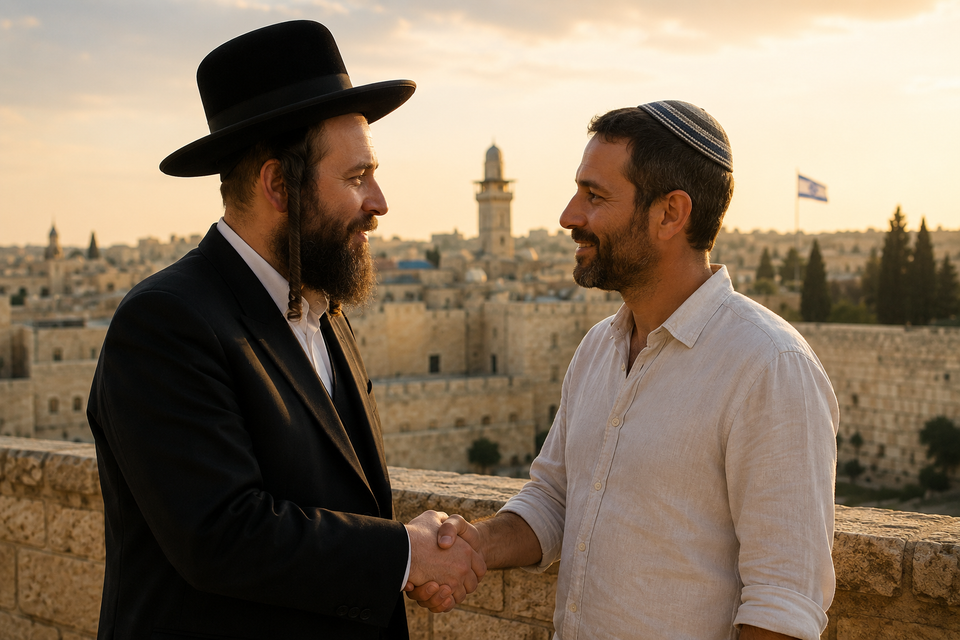
The question is asked sometimes in genuine confusion and sometimes in open suspicion, and it deserves a straight answer. Yes — Charedim oppose the ideology of Zionism, insofar as it was built to replace Torah with nationalism. And no — Charedim are not anti-Jew, not anti-Israel, not wishing harm on a single Zionist, and not in the camp of those who deny Jews the right to their own land. The whole of the matter rests on one distinction the outside world keeps missing: we reject the ism, never the people who carry it.
It helps to be precise even about the word. The hardline Torah communities — Satmar, the Eidah HaChareidis — are anti-Zionist in the full sense, holding the secular state to be illegitimate on the basis of the Three Oaths. The larger Litvishe and Agudah mainstream is better described as non-Zionist: it rejects the ideology and refuses to call the state "the first flowering of our redemption," yet lives within it pragmatically and seeks no rebellion. But across that whole spectrum runs a single shared core — opposition to an ideology, combined with love for every Jew alive and reverence for the land itself.
I. What the Ideology Claimed — and What the Gedolim Rejected
To understand the objection, you have to understand what Zionism, in its founding secular form, actually proposed. It set out to redefine the Jew. For three thousand years a Jew was a soul bound to Hashem, to His Torah, and to His mitzvos. Secular Zionism offered a different definition: a Jew as a member of a nation like any other, bound by land, language, and national feeling, free at last from the "old" religion. For a significant part of its early leadership, this was not a supplement to Torah but a conscious substitute for it — a "new Jew" who would leave Sinai behind.
That — and only that — is what the Gedolim opposed, and they opposed it from the very first. Rav Elchonon Wasserman, Hy"d, taught that secular Zionism was no stepping-stone toward Torah but a rebellion against it, an attempt to build Jewish peoplehood on everything except the one thing that ever made the Jewish people a people. The objection was theological, not tribal — and it was always, without exception, aimed at the ideology and never at the Jews who had been raised inside it.
II. The Ism, Not the People
This is the line that the caricature of "Charedi anti-Zionism" cannot hold onto, so it is worth stating as plainly as possible. A Jew who calls himself a Zionist is still a Jew — with a neshama, with a share in Sinai, our own brother. As Rav Aharon Kotler conveyed, we do not hate such a Jew; if anything, we ache for him. To oppose an ideology is not to despise the human beings shaped by it, any more than a doctor despises a patient by naming his illness. The Torah world's quarrel was with a set of ideas that sought to unseat the Torah — never with the millions of beloved Jews who inherited those ideas without ever choosing them.
III. We Are Not the Secular Anti-Zionists
And here a second confusion has to be cleared away, because it is the mirror image of the first. Charedim have nothing whatsoever in common with the secular and far-left anti-Zionists who deny that Jews have any right to live in Eretz Yisrael at all. That position we reject utterly. Eretz Yisrael is our holy land — the gift of Hashem to the children of Avraham, Yitzchak, and Yaakov, promised and deeded in the Torah itself. The Charedi objection has never been to the return of Jews to their land. It has been to the erasure of Torah from that return. We believe the Jewish people are meant to come home through teshuvah and redemption, not through a nationalism cut loose from the God who gave us the land in the first place. We are not against the Jewish return. We are against a homecoming that leaves the Master of the Home outside.
IV. And Certainly Not the Fringe Who Embrace Our Enemies
There is one more group from which the Torah world separates itself completely, publicly, and without reservation: the tiny fringe — Neturei Karta and their like, perhaps a few thousand souls — who turn up at anti-Israel rallies draped in keffiyehs and who, in 2006, traveled to Tehran to sit at Mahmoud Ahmadinejad's Holocaust-denial conference and embrace the man openly calling for Israel's destruction. Whatever they imagine they are doing, this is not daas Torah. It is a chillul Hashem, and it was named as such by the entire spectrum of the Torah world — Litvish, Chassidish, and Sephardi alike, from the Agudah leadership, who called it aiding and abetting the enemy, to the chareidi press, which branded the participants outcasts in Jewish garb.
The most important voice of all here is Satmar's. Satmar holds the most uncompromising anti-Zionist position in the Torah world — and precisely for that reason its response is decisive. When those Neturei Karta members embraced Ahmadinejad, the Satmar Rebbetzin's court issued an extraordinary public statement calling on all who hold the honor of Heaven and the Torah dear to distance themselves from such people, to condemn their actions, and to give them no encouragement whatsoever, warning that to stand with the enemies of the Jews in this way is to help desecrate the Name of Heaven. This was no innovation; it was the lifelong principle of the Satmar Rav, Rav Yoel Teitelbaum himself, who fought Zionism with every fiber of his being and yet never once sanctioned siding with those who sought Jewish blood. One can argue with a fellow Jew about Zionism to the end of one's days. One may never stand beside those who want him dead.
For the truth is the opposite of what the fringe suggests. We mourn every Jewish soul taken by terror. We cry over every wounded soldier. We care, with everything in us, for our brothers and sisters — whether they wear a black hat, a knitted kippah, or nothing on their heads at all.
V. What We Want: Illumination, Not Defeat
So if the goal is not to harm Zionists, what is it? Not to defeat them — to enlighten them. The Charedi dream for the Jews of Israel is not political but spiritual: that every Jew, left or right, secular or searching, should one day taste the beauty of Torah, the sweetness of a mitzvah, the warmth of a Shabbos table, and remember where he comes from — Har Sinai. Rav Michel Yehuda Lefkowitz expressed the whole hope simply: let a Jew genuinely taste Torah, let him sit at a real Shabbos table, and something in him will remember who he is. We want a Jewish state that reflects the ratzon Hashem rather than military pride alone; we want peace, but not a peace bought by silencing Torah; we want unity, but never uniformity; we want redemption — but the kind that comes from Above.
VI. From Kibbutz to Kollel: The Story of Rav Uri Zohar
No life captures this better than that of Rav Uri Zohar. Born in Tel Aviv in 1935, he became one of the brightest icons of secular Israeli culture — an actor, director, comedian, and satirist whose films and television appearances made him a household face through the 1960s and '70s. In 1976 he was awarded the Israel Prize for cinema, the state's highest civilian honor — and he turned it down. For at the height of his fame, something had begun to stir in him, and in the late 1970s, after learning first at Ohr Somayach and then in the yeshiva of Rav Yitzchak Shlomo Zilberman, Uri Zohar walked away from all of it — the career, the wealth, the adulation — and traded a mansion for a tiny Jerusalem apartment and a life of Torah. His teshuvah shook the Israeli cultural establishment to its foundations, and it opened a door through which thousands more would follow.
He went on to become a leader of the teshuvah movement and the public face of Lev L'Achim, the kiruv organization that has reached tens of thousands of Jews. At his levaya in 2022, the director of Lev L'Achim said that there is scarcely a baal teshuvah in Eretz Yisrael over the last several decades who does not owe his return, at least in part, to Uri Zohar.
But the deepest thing about him was not the drama of his story; it was what he did with it. He never spoke of his former colleagues in the secular world with a trace of contempt — "I respect that life," he once said of his old career, "the way a grown man remembers his childhood." He spent his remaining decades pleading with the Torah world to open its heart to secular Jews, insisting that they are not our enemies but our brothers, that he had been one of them, and that what had reached him was never condemnation but the sweetness of Torah and the dignity of being treated with love. His life is the entire argument of this article made flesh: Zionism cannot replace Torah — and yet the very symbol of secular Israel could become a beloved talmid chacham, not because anyone defeated him, but because someone saw the neshama inside him and loved him home.
VII. The Bottom Line
So — are Charedim anti-Zionist? Yes, in the one specific sense that we oppose the replacement of Torah with nationalism. And no, in every other sense there is. We love every Jew. We daven for the peace of Am Yisrael. We pour ourselves into this nation through Torah, through chesed, through tefillah, and through care for every Jewish soul.
In the end, the real question was never who is a Zionist and who is not. It is who is working to bring Hashem back to the center of the life of the Jewish people. And in that labor, we welcome every single Jew — with open arms, and with a love that does not depend on what he believes today.
May Hashem plant love between every Jew and his brother, draw all His children home to His Torah in gentleness and joy, and bring the redemption we all await — bimheirah b'yameinu, amen.
Sources
The opposition to the ideology
- Rav Elchonon Wasserman, Hy"d (Ikvesa d'Meshicha) — that secular Zionism is not a path toward Torah but a rebellion against it
- Rav Aharon Kotler — that a Jew who identifies as a Zionist remains a beloved brother, to be ached over rather than hated
- Rav Michel Yehuda Lefkowitz — that a Jew who genuinely tastes Torah and a Shabbos table is reminded of who he truly is
The rejection of the enemy-embracing fringe
- The condemnation of the Neturei Karta members who attended the Tehran Holocaust-denial conference in December 2006 by the Satmar community, the Agudah leadership, and the broad Torah world — calling the public to distance itself from them and warning that to stand with the enemies of the Jews desecrates the Name of Heaven; the lifelong principle of Rav Yoel Teitelbaum, fiercely anti-Zionist yet never sanctioning alliance with those who seek Jewish blood (the 2006 statement issued by the Satmar court after his passing)
The path of illumination
- The life of Rav Uri Zohar (1935–2022) — icon of secular Israeli cinema, recipient (and refuser) of the 1976 Israel Prize, who became a leading baal teshuvah and head of Lev L'Achim, and who taught that secular Jews are reached through love and the sweetness of Torah, never through condemnation
The structural relationship to other articles in this series
- "Is Zionism Working?" and "Is Zionism One of the Seventy Faces of Torah?" — the ideology examined directly
- "The Charedi View on Neturei Karta and Iran" — the fringe addressed in full
- "Sinas Chinam and Ahavas Yisrael" — the love that underlies the whole position
- "The Charedi Approach to Kiruv" — illumination rather than defeat